
 en
en 中文简体
中文简体 русский
 Español
 Deutsch
 Polskie
 REQUEST A QUOTE


Design features of high performance kayak mold tooling
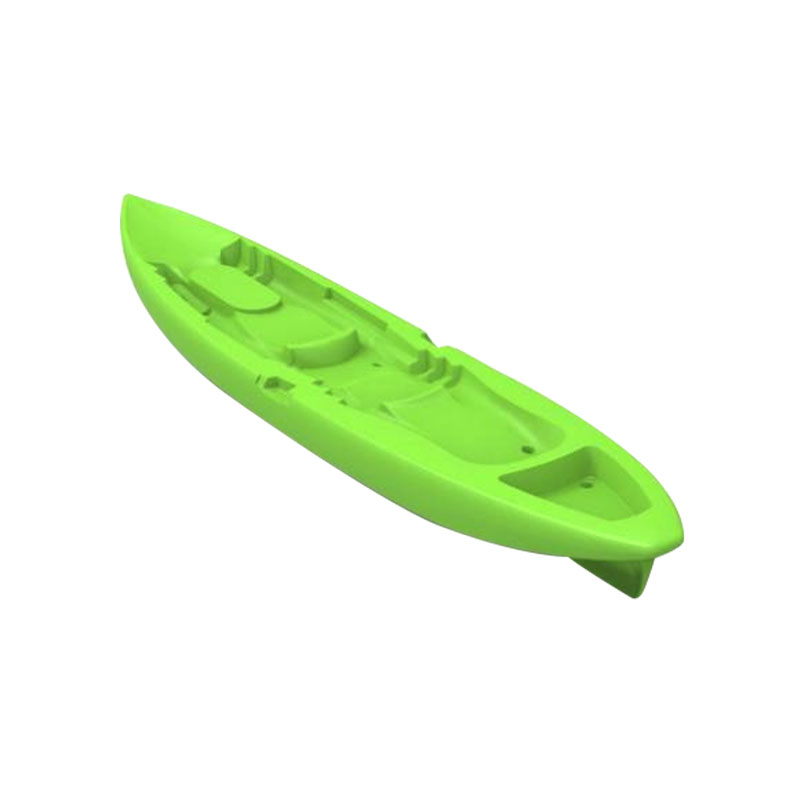
High-performance kayak production depends heavily on tooling quality. A well-engineered kayak mold must provide dimensional stability, reliable wall thickness, smooth surfaces, structural consistency, and efficient release throughout repeated rotational molding cycles. For manufacturers producing recreational, touring, fishing, or competition kayaks, tooling is not simply a forming device; it is a fundamental part of product engineering. Modern rotomolded polyethylene boat tooling must therefore balance strength, thermal behavior, manufacturability, and customization. A properly designed mold can support one-piece construction while reducing weak points and eliminating weld lines that may compromise watertight performance.
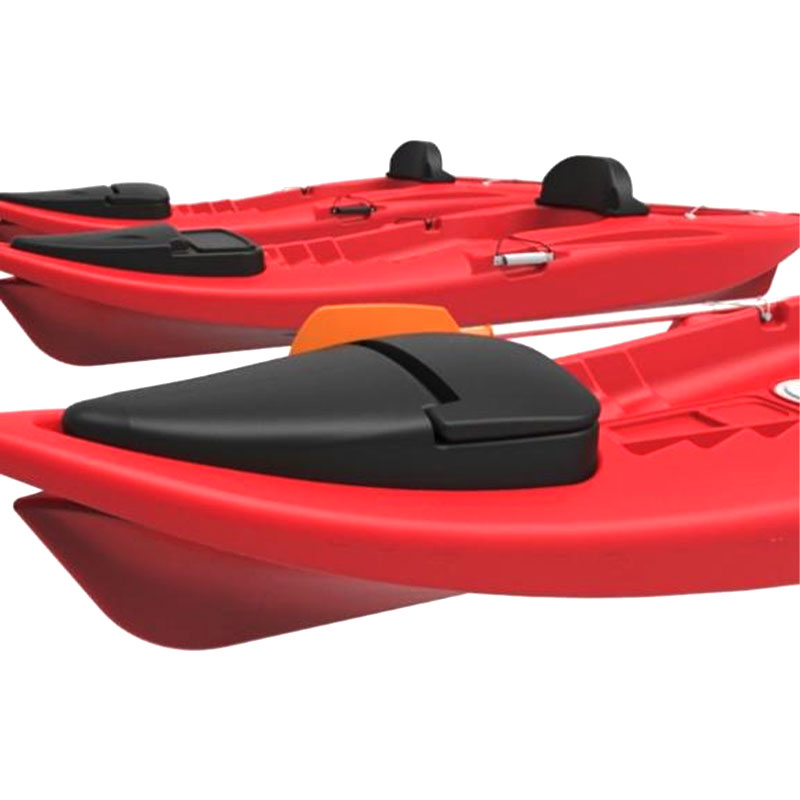
The one-piece rotational molding approach is particularly suitable for hollow watercraft because polyethylene can be distributed throughout a closed mold during controlled heating and rotation. The resulting kayak shell can achieve a continuous structure without conventional joining seams. This approach is useful for fishing kayak manufacturing, recreational watercraft, touring vessels, and specialized marine products. At the same time, custom watercraft mold design allows manufacturers to adapt hull dimensions, cockpit geometry, storage areas, mounting points, handles, and other features to specific market requirements.
Recreational Kayak Mold Tooling
Recreational kayak tooling is generally designed for dependable production, comfortable handling, and broad market compatibility. The mold must reproduce the hull contour accurately while allowing sufficient internal space for polyethylene powder to form a consistent shell. A high-quality kayak mold for recreational products should incorporate smooth transitions around corners, carefully controlled parting areas, and practical features that simplify demolding. Because recreational kayaks are often produced in different lengths and configurations, the tooling should also support flexible engineering development.
The one-piece structure is one of the most important advantages of this category. Instead of relying on separate shell sections and extensive joining operations, rotational molding can create a seamless hollow body. This improves manufacturing consistency and reduces potential leakage points. Rotomolded polyethylene boat tooling is particularly valuable where impact resistance and practical durability are more important than extremely lightweight construction. Recreational kayaks may be used on lakes, rivers, coastal waters, and rental operations, so their molds must support robust finished products.
For manufacturers developing several recreational models, custom watercraft mold design provides an efficient way to translate different product concepts into production-ready tooling. Mold engineers can evaluate product dimensions, structural requirements, manufacturing conditions, and expected production volume before finalizing the design. Jiangsu Zhroto Mould Co., Ltd. provides integrated services covering project evaluation, product optimization, 3D engineering, mold manufacturing, trial production, inspection, and technical support, making the tooling development process more systematic.
- Suitable for single-person recreational kayaks and general leisure watercraft.
- Supports seamless hollow structures with consistent surface quality.
- Can accommodate customized hull lengths, shapes, storage features, and accessory positions.
- Designed for repeatable production on conventional and electric-heated rotational molding machines.
Fishing Kayak Manufacturing Tooling
Fishing kayaks require a more specialized tooling strategy because the finished product must accommodate both water performance and practical fishing functions. A mold intended for fishing kayak manufacturing may need to reproduce recessed storage compartments, rod holders, equipment mounting areas, seat locations, and carefully positioned structural features. These elements should be integrated into the mold without creating unnecessary sharp transitions that could interfere with material distribution or product release.
In this category, kayak mold construction must pay close attention to the relationship between external hull geometry and internal functional areas. Fishing users may place additional equipment on the deck, so the final shell requires dependable rigidity and impact resistance. Rotational molding offers an attractive production method because it can produce a durable one-piece polyethylene body with relatively few secondary joining operations. Rotomolded polyethylene boat tooling therefore provides a practical foundation for fishing-oriented watercraft that must withstand repeated loading, transport, launching, and contact with docks or rocky shorelines.
The design process should begin with the intended fishing environment and product configuration. A river fishing kayak may require different geometry from a stable recreational fishing platform designed for calm coastal water. Through custom watercraft mold design, manufacturers can refine dimensions, deck layouts, storage zones, and other functional elements before machining begins. Jiangsu Zhroto Mould Co., Ltd. supports this process through product design optimization, CAD-based 3D engineering, mold confirmation, precision manufacturing, sample validation, and quality inspection.
- Evaluate the intended water environment, user requirements, and product dimensions.
- Optimize hull and deck geometry for rotational molding manufacturability.
- Develop detailed three-dimensional tooling data and confirm the mold structure.
- Manufacture the tooling using precision machining processes.
- Conduct mold trials, inspect samples, and refine production parameters when necessary.
Touring and Tandem Kayak Mold Solutions
Touring and tandem kayaks introduce additional tooling requirements because their larger dimensions can increase demands on mold stability, handling, thermal distribution, and dimensional control. The product description supports kayak sizes ranging from approximately three-meter single-person recreational models to five-meter tandem touring models. This range demonstrates why a high-performance kayak mold should be engineered around the specific product rather than treated as a generic tooling platform.
Longer hulls require careful control of the mold structure and forming cycle. A well-designed rotomolded polyethylene boat tooling solution must maintain dimensional stability during heating and cooling while allowing the polymer to form evenly over curved surfaces. Smooth transitions, appropriate reinforcement, reliable closures, and practical handling structures contribute to tooling durability. Compared with smaller recreational molds, touring and tandem tooling places greater emphasis on structural support and manufacturing repeatability.
For touring applications, fishing kayak manufacturing principles may overlap with general watercraft requirements, particularly when the vessel includes storage compartments and equipment areas. However, touring products typically place greater emphasis on hull tracking, internal capacity, passenger arrangement, and long-distance usability. Jiangsu Zhroto Mould Co., Ltd. has experience in large-scale mold machining and complex curved-surface manufacturing, supporting projects that require both large tooling dimensions and precise geometry.
| Product category | Primary positioning | Main tooling focus | Typical application |
| Recreational kayak | Leisure and general use | Reliable geometry and easy production | Lakes, rivers, rental operations |
| Fishing kayak | Fishing functionality | Equipment integration and structural durability | Rivers, lakes, coastal fishing |
| Touring and tandem kayak | Long-distance and multi-user performance | Large-form stability and dimensional control | Touring and extended water activities |
Electric-Heated and Conventional Rotational Molding Compatibility
Tooling performance is also influenced by the heating system used during production. Conventional gas-heated rotational molding remains widely applicable for large hollow plastic products because of its established equipment compatibility and production flexibility. Electric-heated rotational molding introduces more precise thermal management and zoned heating capability, which can place additional demands on mold design and heat-transfer performance. A professional kayak mold supplier should therefore consider the customer's machine configuration during engineering rather than treating every molding system identically.
Since 2023, Jiangsu Zhroto Mould Co., Ltd. has invested in electric-heated rotational molding technology and related manufacturing capabilities. Its solutions are compatible with both conventional gas-heated machines and innovative electric-heating systems. Electric heating can provide temperature control accuracy within approximately 1 to 2 degrees Celsius, independent zoned heating, high thermal efficiency, and potential energy savings. These advantages can help manufacturers manage complex kayak geometries more consistently when the tooling and process are properly matched.
For rotomolded polyethylene boat tooling, thermal considerations are especially important because the mold must support consistent material distribution over long hulls, recessed features, and curved surfaces. Mold construction, material selection, wall configuration, and heating conditions should be evaluated together. The company provides material and process recommendations as part of its integrated service, helping customers select a suitable tooling approach for both product performance and production stability.
Key Engineering Features
High-performance tooling combines structural strength with manufacturing practicality. High-grade mold materials can improve dimensional stability through repeated forming cycles, while precision machining helps reproduce complicated hull curves and functional details. Proper venting, parting design, reinforcement, and surface treatment can also influence release quality and mold service life. These features are especially important when the same mold is expected to support continuous production rather than short-term prototyping.
Custom Watercraft Mold Development and Quality Control
A successful custom watercraft mold design project begins before machining. Product application, dimensions, structure, production requirements, expected output, and machine compatibility should be reviewed at the beginning of the project. This approach helps identify potential manufacturing difficulties while design changes are still practical. For a manufacturer developing a new kayak range, early tooling evaluation can reduce downstream modifications and improve the consistency of the final product.
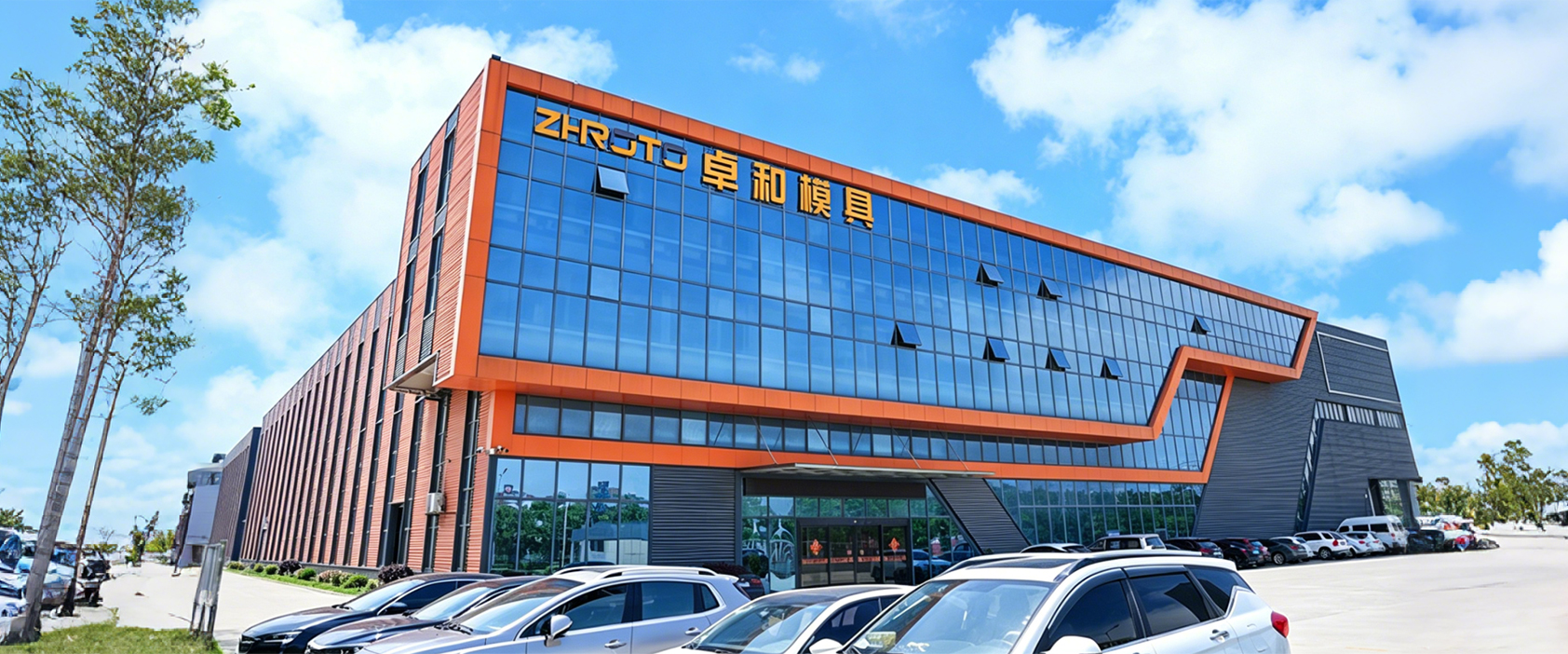
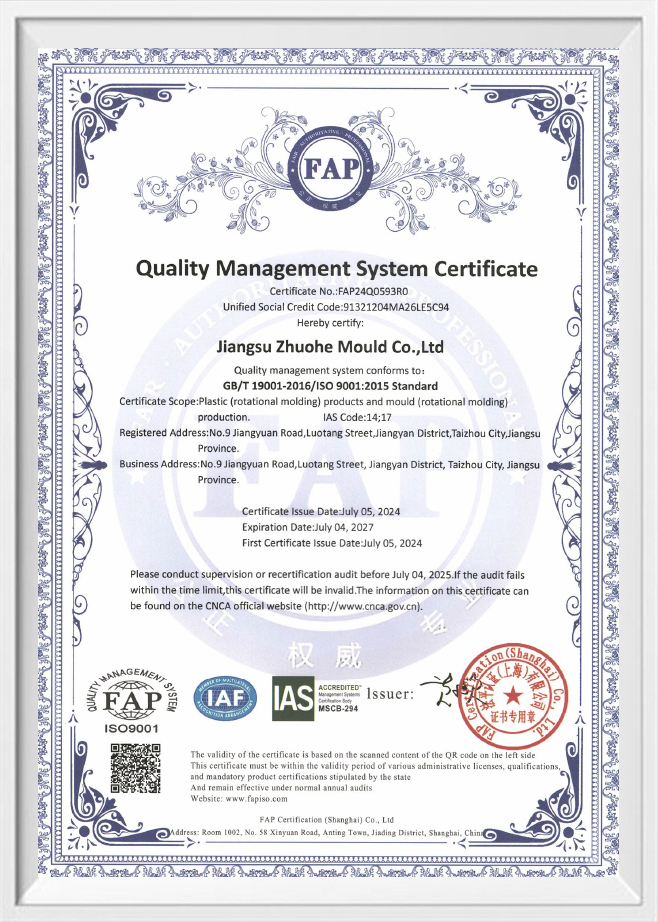
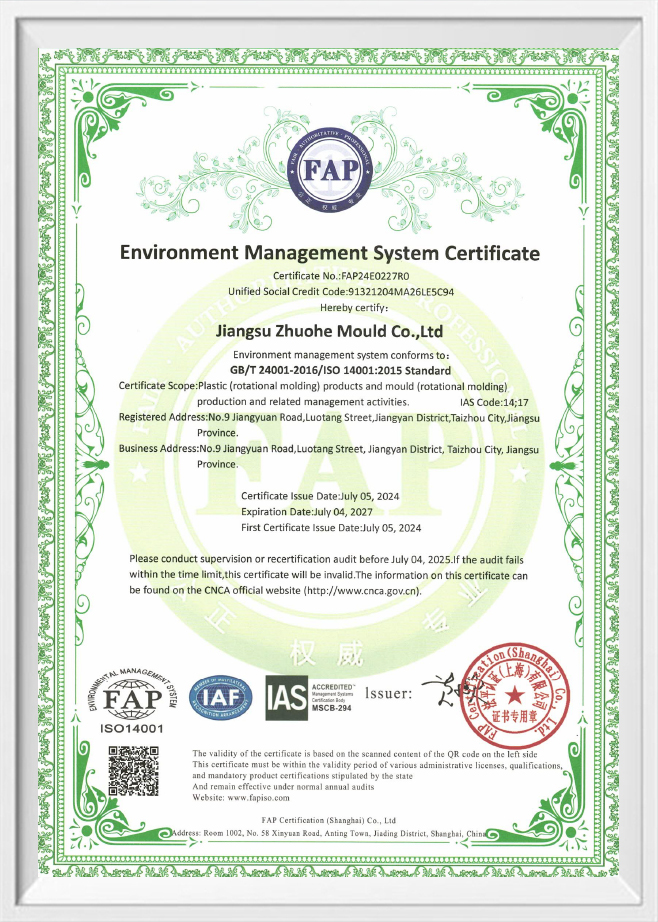
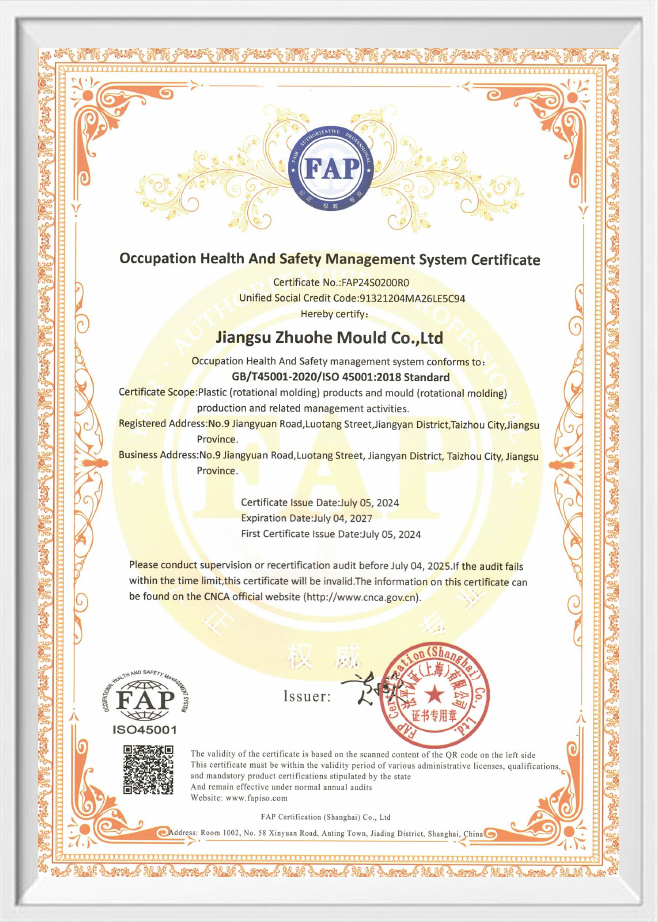
Jiangsu Zhroto Mould Co., Ltd., founded in 2015, specializes in rotational molding mold design, manufacturing, rotomolded product processing, and integrated technical solutions. The company moved to a modern factory in Jiangyan District, Taizhou City, in 2021, with a total land area of 18,000 square meters and standardized workshops exceeding 12,000 square meters. Its annual mold output exceeds 800 sets, while its management systems include ISO 9001:2015, ISO 14001:2015, and ISO 45001:2015 certifications.
For fishing kayak manufacturing, this integrated workflow is valuable because mold quality directly affects finished product consistency. Zhroto Mould can support customers from initial consultation through design optimization, CAD modeling, mold confirmation, CNC manufacturing, trial validation, inspection, delivery, production support, and maintenance advice. This one-stop approach is particularly useful for manufacturers who require customized tooling rather than standardized molds.
The final objective of custom watercraft mold design is not merely to create a mold that produces one acceptable sample. The tooling should support stable production over its service life while maintaining the intended kayak geometry. Careful engineering, accurate machining, controlled testing, and ongoing technical support all contribute to this objective. A well-developed tooling system can help manufacturers produce different kayak categories while maintaining reliable quality and efficient production processes.
Recommended Tooling Evaluation Points
- Review hull geometry and product dimensions before mold construction.
- Confirm machine compatibility and heating method.
- Assess material distribution around corners, recesses, and complex curves.
- Check mold dimensional stability during repeated heating and cooling.
- Validate sample quality before moving into continuous production.
- Establish maintenance and technical support procedures for long-term use.
Frequently Asked Questions
Q1: What makes a high-performance kayak mold different from basic tooling?
A high-performance kayak mold emphasizes dimensional stability, smooth complex surfaces, reliable release, consistent material distribution, and long-term production durability. It is engineered around the final kayak design and the specific rotational molding process rather than serving as a generic forming tool.
Q2: Why is rotational molding suitable for fishing kayaks?
Rotational molding can produce durable hollow polyethylene structures with a continuous body and minimal joining operations. This makes fishing kayak manufacturing practical for products requiring impact resistance, integrated storage areas, equipment mounting features, and dependable outdoor performance.
Q3: Can the tooling support different kayak sizes?
Yes. The described one-piece tooling concept can be customized for different product dimensions, including approximately three-meter single-person recreational kayaks and five-meter tandem touring kayaks. The mold must be engineered specifically for each intended product geometry and production requirement.
Q4: Can custom watercraft tooling work with electric-heated machines?
Yes. Rotomolded polyethylene boat tooling can be engineered for both conventional gas-heated and electric-heated rotational molding systems. Electric heating offers more precise temperature management and zoned heating, while the mold design must be developed with appropriate thermal and structural considerations.
Q5: What services does Zhroto Mould provide?
Jiangsu Zhroto Mould Co., Ltd. provides project consultation, product optimization, 3D modeling, mold design confirmation, precision manufacturing, material and process recommendations, trial validation, quality inspection, delivery, production support, and mold maintenance advice. Its integrated capabilities allow customers to manage both tooling development and rotational molding technical requirements through one professional service process.
Q6: How does custom watercraft mold design improve production?
A customized approach allows the tooling team to consider product geometry, machine type, material behavior, production volume, functional features, and quality requirements together. This can reduce manufacturing difficulties, improve dimensional consistency, and create tooling better suited to the manufacturer's long-term production objectives.
 +86-18006248936
  ricky.t@zhroto.com
  No.9 Jiangyuan Road, Luotang Street, Jiangyan District, Taizhou City,Jiangsu Province, China