 en
en 中文简体
中文简体 русский
 Español
 Deutsch
 Polskie
 REQUEST A QUOTE

 Home / News / Industry News / Why Cold Chain Insulation Boxes and Military Boxes Demand Different Rotational Mold Engineering
 Why Cold Chain Insulation Boxes and Military Boxes Demand Different Rotational Mold Engineering
Content
- 1 Two Enclosures, Two Engineering Problems
- 2 Engineering a Cold Chain Insulation Box Rotational Mold for Thermal Performance
- 3 Structural Requirements for a Military Box Rotational Mold
- 4 Wall Construction and Foam-Fill Strategy: A Side-by-Side Comparison
- 5 Manufacturing Process Flow for Both Enclosure Types
- 6 Drop-Test and Thermal Compliance Benchmarks
- 7 Resin Selection: Where the Two Applications Converge
- 8 Frequently Asked Questions
- 8.0.1 Q1: Can one mold base produce both a cold chain shell and a military-grade transit case?
- 8.0.2 Q2: Why do cold chain boxes use two separate shells instead of one thick wall?
- 8.0.3 Q3: What causes uneven wall thickness in a rotomolded shell?
- 8.0.4 Q4: How is drop-test performance validated for transit cases?
- 8.0.5 Q5: Does foam fill affect the structural strength of a cold chain box?
Two Enclosures, Two Engineering Problems
A logistics cooler and a rugged transit case look similar from across a warehouse floor: both are hollow, seamless, single-piece polyethylene shells produced on rotational molding equipment. Underneath the surface, the design targets diverge sharply. One enclosure is built to hold a stable internal temperature for days. The other is built to survive repeated impact, vibration, and stacking loads without deforming. Treating them as the same product with a different paint job leads to underperformance in the field: thermal drift in cold chain boxes, or hinge and wall failure in transit cases under load.
This article breaks down the mold and wall-construction decisions that separate a cold chain insulation box rotational mold from a military box rotational mold, and where the two disciplines actually overlap.
Engineering a Cold Chain Insulation Box Rotational Mold for Thermal Performance
Cold chain enclosures are judged almost entirely on one metric: how long the internal cavity stays within a target temperature band once ambient conditions change. The mold geometry has to accommodate a double-walled shell with a defined foam cavity, consistent wall spacing, and clean corner radii, since sharp internal corners create thin foam zones and thermal bridging.
- Wall spacing typically ranges from 25mm to 60mm depending on payload duration requirements
- Corner radii are kept generous to avoid foam voids during the pour-in-place or injected-foam stage
- Mold venting is positioned to prevent trapped air pockets in the outer shell during rotation
- Drain channel bosses are molded in to allow condensate management inside the cavity
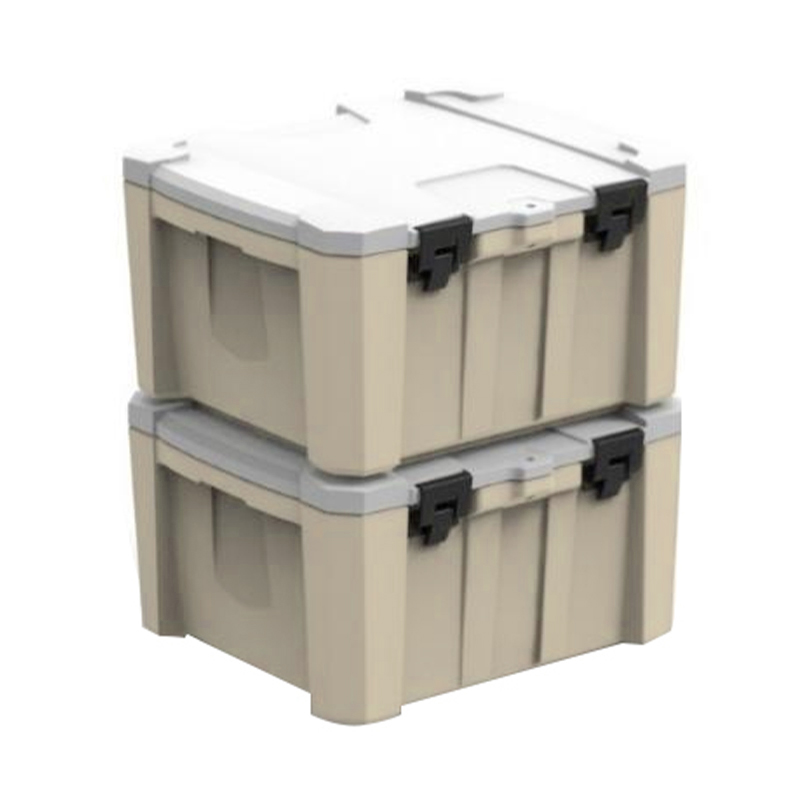
The inner and outer shells are usually rotomolded as two separate parts on the same mold base, using a shuttle or clamshell arrangement, then joined and foam-filled afterward. Wall thickness uniformity between the two shells matters more here than in most other rotomolded parts, because uneven thickness creates localized weak points where heat transfer accelerates.
Structural Requirements for a Military Box Rotational Mold
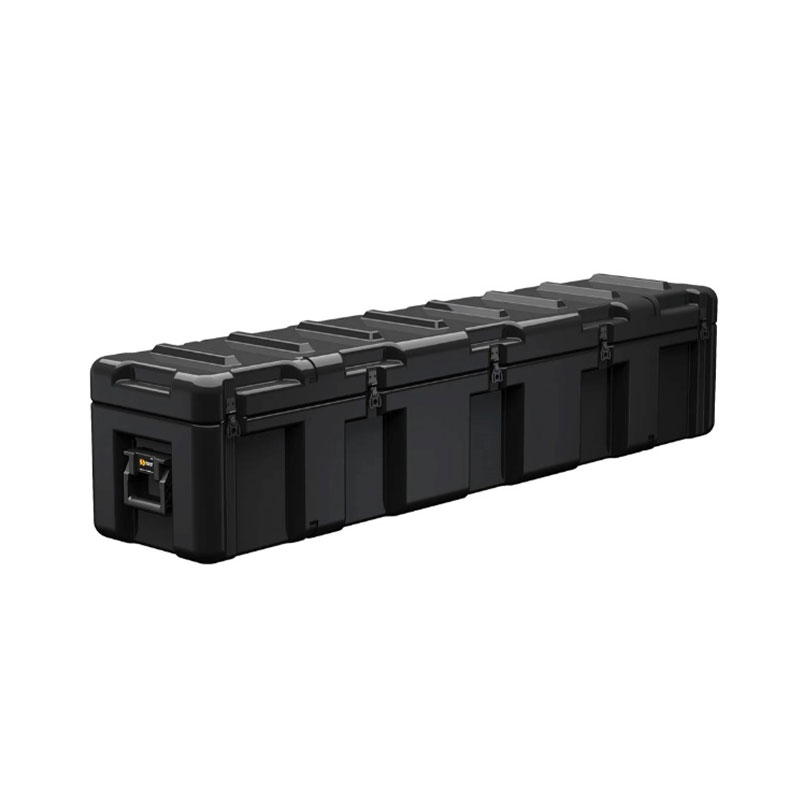
A military-grade transit case mold is judged on a different scorecard: drop resistance, stacking strength, and dimensional stability under repeated load cycles. Insulation is secondary or absent. The mold instead needs reinforced rib patterns, gasket channel grooves, and precise mounting boss placement for hinges, latches, and pressure relief valves.
Core Structural Features Built Into the Mold
- Interlocking rib grid on interior walls to distribute impact load away from a single point
- Recessed gasket channel around the lid perimeter for a compression seal
- Reinforced corner sections, often with thicker wall zones molded through longer dwell time in that area
- Stacking feet and rails molded directly into the base for pallet compatibility
Because these cases are frequently a single rotomolded shell rather than a double-wall assembly, wall thickness control depends heavily on oven temperature uniformity and rotation ratio during the molding cycle, rather than on a secondary foam-fill step.
Wall Construction and Foam-Fill Strategy: A Side-by-Side Comparison
The table below summarizes where the two mold types diverge in practical production terms.
| Design Factor | Cold Chain Insulation Box | Military Transit Box |
|---|---|---|
| Wall structure | Double shell with foam cavity | Single reinforced shell |
| Primary performance goal | Thermal retention | Impact and load resistance |
| Foam fill | Pour-in-place or injected PU foam | Rarely used, occasionally partial |
| Corner geometry | Large radii to prevent thin foam zones | Reinforced, thicker wall corners |
| Hardware bosses | Minimal, drain and handle only | Extensive for hinges, latches, valves |
| Typical wall thickness | 4mm to 6mm per shell | 6mm to 10mm single wall |
Manufacturing Process Flow for Both Enclosure Types
Despite the design differences, both parts follow the same core rotomolding sequence, with divergence appearing mainly in post-mold assembly.
The assembly step is where the two products separate: cold chain shells move into foam injection and shell bonding, while transit case shells move into hardware installation, gasket seating, and pressure valve fitting.
Drop-Test and Thermal Compliance Benchmarks
Field performance data from logistics and defense-adjacent transit operations gives a useful reference point for setting internal quality targets.
Thermal Hold Time
A well-designed rotomolded insulation shell with 40mm foam cavity commonly holds a 5 degree band for 48 to 72 hours in ambient conditions near 25C, depending on payload mass and phase-change material use.
Drop Resistance
Reinforced transit cases are commonly tested to a 1.2 meter drop onto a hard surface across multiple orientations, with pass criteria requiring no cracking at rib intersections or hinge bosses.
Stacking Load
Palletized transit cases are frequently rated to support four to six units stacked, translating to a static load requirement well above the empty case weight.
Resin Selection: Where the Two Applications Converge
Both product families typically rely on linear or cross-linked polyethylene as the base rotomolding resin, chosen for impact toughness at low temperatures and resistance to environmental stress cracking. The distinction is in additive packages rather than base polymer family.
| Resin Attribute | Cold Chain Priority | Military Case Priority |
|---|---|---|
| UV stabilization | Moderate | High, for extended outdoor storage |
| Impact modifiers | Moderate | High |
| Low-temperature toughness | High | High |
| Color consistency | Secondary | Often specified for camouflage or ID coding |
Whether the finished part is a double-walled insulation shell or a rugged single-wall case, the rotational molding cycle itself, mold rotation ratio, oven residence time, and cooling rate, has to be tuned to the specific wall thickness target for that part, since a cycle profile suited to a thin-wall cold chain shell will under-cure a thick-wall military case wall section.
Frequently Asked Questions
Q1: Can one mold base produce both a cold chain shell and a military-grade transit case?
Generally no. The rib patterns, hardware boss placement, and wall thickness targets differ enough that separate mold tooling is standard practice, even when both parts share the same resin family.
Q2: Why do cold chain boxes use two separate shells instead of one thick wall?
A single very thick rotomolded wall is difficult to cool evenly and tends to warp. Two thinner shells with a foam-filled cavity between them give better thermal performance and more predictable production quality.
Q3: What causes uneven wall thickness in a rotomolded shell?
Inconsistent oven temperature distribution, incorrect rotation speed ratio between the major and minor axes, or resin that has not been sized and dried correctly before charging the mold.
Q4: How is drop-test performance validated for transit cases?
Cases are typically dropped from a specified height in multiple orientations, edge, corner, and flat face, then inspected for cracking, hinge separation, or seal failure before being cleared for the intended load rating.
Q5: Does foam fill affect the structural strength of a cold chain box?
Yes, rigid PU foam adds meaningful compressive strength to the double-wall assembly, though the primary purpose remains thermal insulation rather than structural reinforcement.

We provide customers with one-stop services ranging from product design, mold manufacturing to finished product production.
-
 +86-18006248936
 -
 ricky.t@zhroto.com
 -
 No.9 Jiangyuan Road, Luotang Street, Jiangyan District, Taizhou City,Jiangsu Province, China
Copyright © Jiangsu Zhroto Mould Co., Ltd. Rights Reserved.Custom Rotational Plastic Molding Factory
