 en
 中文简体
 русский
 Español
 Deutsch
 Polskie
 REQUEST A QUOTE

 Home / News / Industry News / Custom Rotational Molding Solutions: Mold Design, Tooling and Production
Custom Rotational Molding Solutions: Mold Design, Tooling and Production
Content
- 1 What a Complete Custom Solution Should Include
- 2 Five Decisions That Lock In Cost and Quality
- 3 Tooling Material Follows Batch Size
- 4 Wall Thickness and Tolerances: Get the Numbers in Writing
- 5 Matching Mold and Resin to the Application
- 6 What a Single-Source Mold and Part Supplier Changes
- 7 Procurement Checklist Before You Place the Order
- 8 Frequently Asked Questions
A buyer sends a 900-litre water tank drawing to four mold makers. Three quotes land within a few hundred dollars of each other; the fourth is 30 percent higher. The cheaper quotes usually win the meeting. Six weeks later, the first article comes back thin at the corners, the parting line runs across a visible face, and wall thickness varies by more than 20 percent from one end to the other.
Custom rotational molding solutions exist to prevent that. A custom program is not a catalog mold with a few dimensions stretched; it is a set of engineering decisions settled before any aluminum is cut, covering parting line, draft, wall thickness, tooling material, resin shrinkage, and the process window that connects them. Get those on paper and the mold price becomes predictable. Skip them and the lowest quote becomes the most expensive project on the floor.
What a Complete Custom Solution Should Include
A supplier should hand over four deliverables, not one. If any of them is missing, the job is not finished, however good the sample looks.
- A mold built to the machine it will run on, including arm swing, oven envelope, and mounting plate dimensions, not just the part drawing.
- A first-article sample with measurements: wall thickness at defined points, critical dimensions, and part weight.
- A documented process window covering resin charge weight, oven time, rotation ratio, and cooling method, with the tolerance around each variable.
- A repeatable part, confirmed across two or three consecutive cycles so the result is a process rather than a lucky shot.
Custom tooling earns its premium when geometry, resin, or annual volume falls outside what a standard mold can absorb. A 40-litre flowerpot mold is a shelf item; a 900-litre tank with an internal baffle, a threaded drain boss, and a UV-stabilized resin package is not. Before quoting, a serious supplier will ask about part function, machine envelope, annual volume, and which dimensions actually matter. If nobody asks, what you receive is an estimate, not a quotation. Those early scope questions are set out in the custom project scope and design support process.
Five Decisions That Lock In Cost and Quality
Each of these is cheap to change on a screen and expensive to change on a finished mold.
| Design decision | Why it drives cost | Practical working range |
|---|---|---|
| Parting line position | Sets the number of mold sections, the visible seam, and the trimming step | Keep it on a flat, low-stress face away from sealing surfaces |
| Draft angle | Tighter draft raises release force, distortion, and scrap rate | 1 to 3 degrees is typical; add more for textured surfaces |
| Wall thickness | Directly sets resin weight, cycle time, and stiffness | 3 to 12 mm for most parts; thicker walls need longer oven time |
| Inserts, bosses, threads | Every insert adds machining, a fixture, and a possible leak path | Decide before tooling; retrofitting usually means a new mold plate |
| Mold material and finish | Controls cycle time, mold life, and how the surface reads to the end user | Match it to total batch size, not to the first order |
Complex geometry is where a custom program usually pays for itself, since a standard tool cannot absorb deep draws, undercuts, or an integrated handle. The constraints that come with those parts are examined in this breakdown of how custom rotational molding solves complex industrial design challenges.
Tooling Material Follows Batch Size
Aluminum is not a budget compromise and steel is not automatically better. The right choice follows the total number of parts the tool must produce, the size of the part, and how fast the cycle needs to run.
| Tooling option | Best fit | Strength | Trade-off |
|---|---|---|---|
| Cast aluminum | Prototypes and short runs with simple shapes | Lowest tooling cost, fast heat transfer | Shorter mold life, looser dimensional control |
| CNC-machined aluminum | Small to medium runs with demanding geometry | Consistent cavity dimensions, stable thermal behavior | Costs more than cast tooling |
| Fabricated steel | Large parts and long production lives | Longest service life, holds shape under heavy parts | Higher upfront cost, slower heating, longer cycles |
The consequence for buyers is straightforward. A steel mold for a 300-piece run spends money on service life you will never use. A cast aluminum mold on a five-year program produces a worn cavity, drifting wall thickness, and a second tooling invoice two years early. Ask which total quantity the mold is designed for, and write that number into the purchase order.
Wall Thickness and Tolerances: Get the Numbers in Writing
Rotational molding produces a seamless one-piece part with a naturally uniform wall, but the tolerance conversation is not the same as injection molding. Powder distribution is a physical process, and the numbers should reflect that.
- Wall thickness on a well-designed part typically holds within roughly 10 to 15 percent of nominal.
- Dimensional tolerances are usually expressed as a percentage of nominal because shrinkage scales with size; 2 to 5 percent is a realistic band for polyethylene parts.
- Shrinkage allowance depends on the resin and the wall thickness, so the cavity must be cut for the grade you will actually run, not for a generic figure.
- Metal inserts and threaded bosses need their own tolerance and pull-out specification, or the assembly line will find the problem for you.
A tolerance that is never measured is not a tolerance. Mark the dimensions that matter, then require them on the first article inspection report.
Fix the acceptance criteria for cosmetic defects at the same time, because a flow mark on an outdoor furniture panel and one on a fuel tank are not the same problem. Putting both in the same document saves an argument later.
Matching Mold and Resin to the Application
Custom work normally starts from the application rather than the process. Four demanding categories show what changes in the tooling.
Hydrogen storage and transport
Pressure vessels and liners demand uniform wall thickness, controlled ovality, and surfaces free of voids, because every thickness variation becomes a stress point under cycling. The mold has to hold tighter roundness than a water tank, and the process window has to repeat batch after batch.
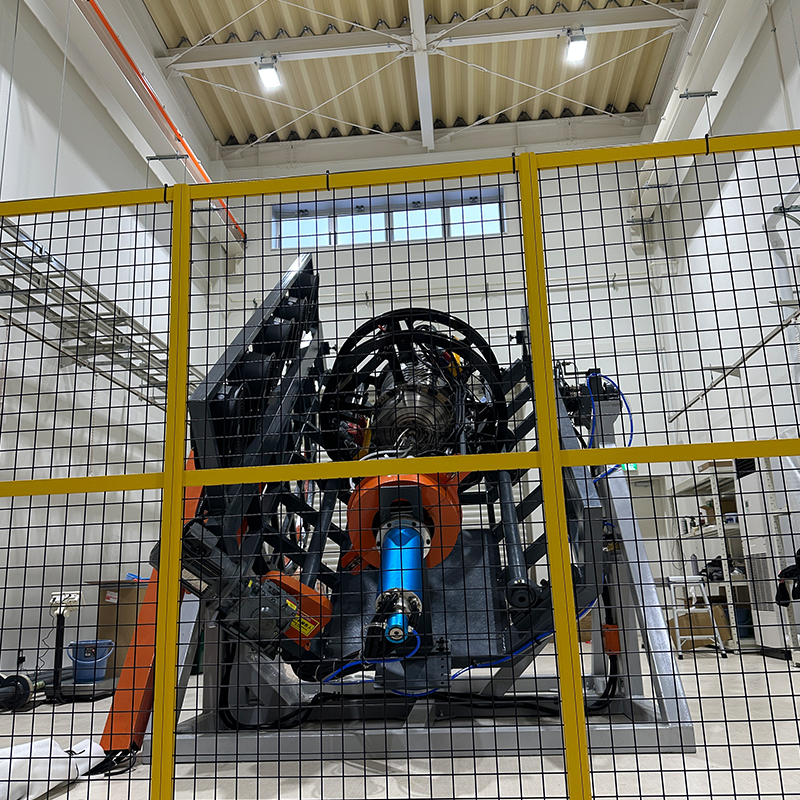 Hydrogen Gas Cylinder Rotational Molding MoldPrecision mold for rotational molding hydrogen cylinder liners and shells, designed for uniform wall thickness and dimensional repeatability in pressure-vessel production.View Product →
Water treatment and storage tanks
Large one-piece tanks benefit from the process more than almost any other product: no seams to leak and no weld lines to fail. Engineering effort shifts to baffles, mounting feet, inlet and outlet bosses, and keeping enough wall thickness at the base where the load sits.
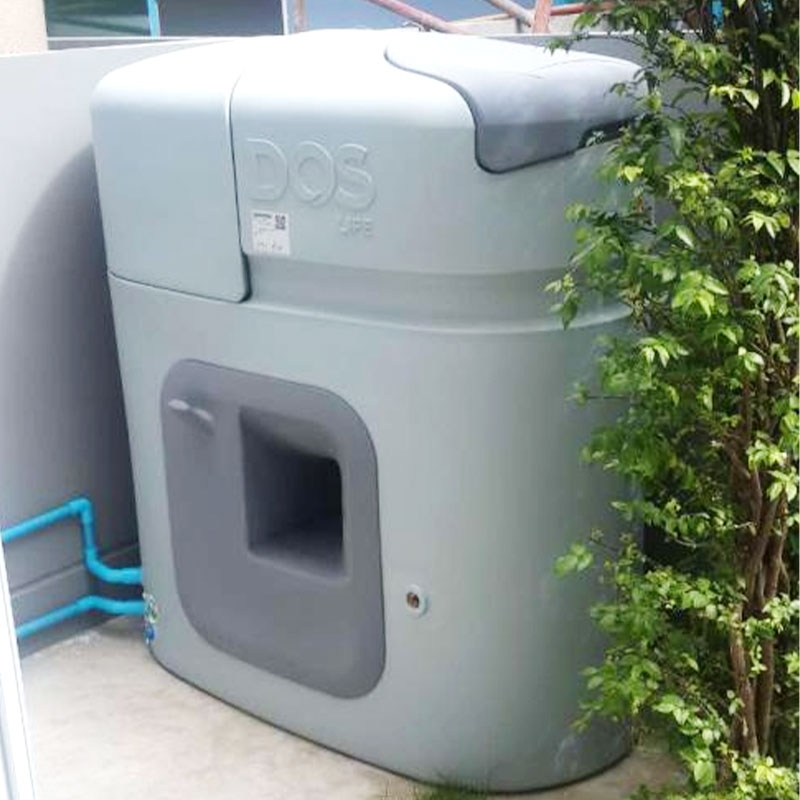 Water Tank Storage Container Rotational Molding MoldSeamless tooling for large plastic water and liquid storage containers, supporting uniform wall thickness and one-piece construction for non-pressurized industrial tanks.View Product →
Automotive fuel tanks
Shape freedom is why rotomolding holds this niche. Saddle tanks and irregular profiles that would need several welded pieces in metal come out in one shot. The constraints are permeation limits, insert placement for the fuel pump module, and dimensional stability across service temperatures.
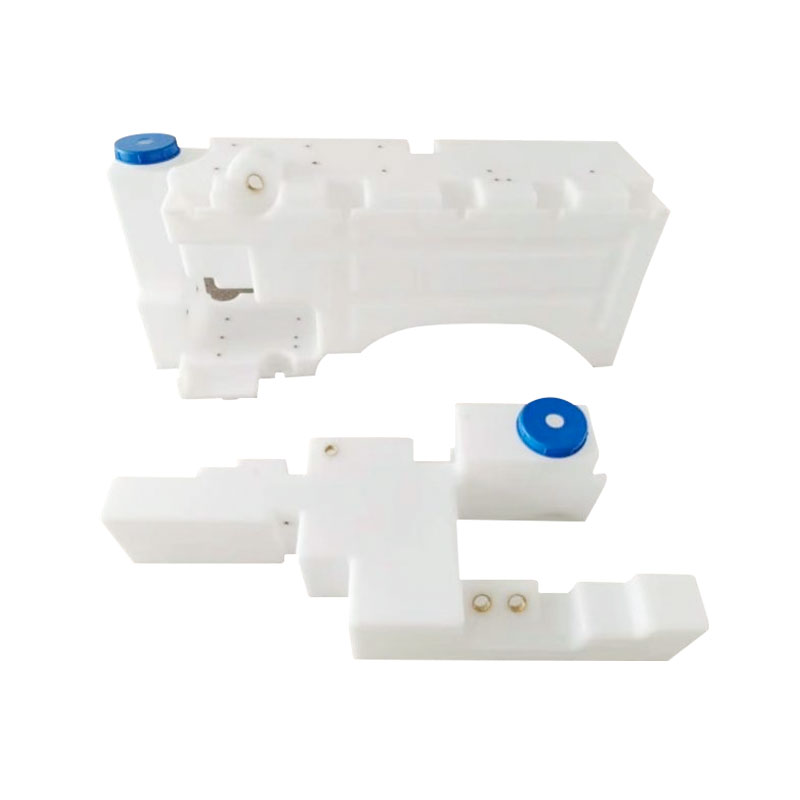 Automobile Fuel Tank Rotational Molding MoldOne-piece plastic fuel tank tooling for complex chassis-fit geometries, supporting seamless construction, weight reduction, and validation for automotive fuel storage.View Product →
Agricultural machinery and outdoor equipment
Parts here are judged on impact resistance, UV stability, and cost per unit. Resin choice matters more than tooling sophistication, though mold wear becomes a real cost when one design runs for years of seasonal production.
Hydrogen storageAutomotiveWater treatmentAgricultural machineryIndustrial equipmentOutdoor facilities
What a Single-Source Mold and Part Supplier Changes
When the tool shop and the molder are two different companies, every quality issue turns into a discussion about whose process is responsible. When they are the same company, the loop shortens to a conversation between the person who cut the cavity and the person who ran it.
800
molds produced per year
3,600
tons of plastic products per year
17
CNC machining and rotomolding machines, or more
12,000
square meters of standardized workshop space
Read those figures as schedule information rather than marketing. A plant with more than 17 machines can hold parallel projects without pushing yours to the back of the queue, and a supplier that runs its own rotomolding lines can test a new cavity within hours of machining it instead of shipping it out and waiting. Certification to ISO 9001, ISO 14001, and ISO 45001 covers the documentation side: traceability, environmental compliance, and worker safety, which matter when a buyer's audit team arrives.
One caveat. Capacity says nothing about whether a supplier understands your part. Ask for the process window from a comparable project, and ask what wall thickness variation was actually achieved, not what is theoretically possible.
Procurement Checklist Before You Place the Order
- Confirm the tooling material and the total quantity the mold is designed for.
- Name the critical-to-function dimensions and the tolerance class that applies to each.
- Request a process window document, not only a sample part.
- Agree on resin grade, shrinkage allowance, and the color or UV package.
- Ask who owns the mold, who maintains it, and how fast repairs can be turned around.
- Require a first article inspection report with wall thickness measured at marked points.
- Confirm cosmetic acceptance criteria in writing before the first production run.
Frequently Asked Questions
Q1: How long does a custom rotomolding mold take to build?
The tool build is usually the longest single step in the schedule. It depends on part size, the number of machined features, and the required surface finish, so ask for a milestone chart covering design freeze, machining, polishing, and first article rather than a single delivery date.
Q2: What is the minimum order quantity for a custom rotomolded part?
There is no fixed number. Tooling is the dominant fixed cost, so the practical minimum is the batch that justifies the mold. A small aluminum tool lets you start at low volume and scale later, while a large steel tool only makes sense when annual volume is high.
Q3: Can one mold produce different wall thicknesses?
Within limits, yes. Charge weight and cycle time control thickness, so a range of roughly plus or minus 20 percent is often achievable without retooling. Beyond that, the cavity design and the resin flow need to change.
Q4: Which resin is used most often?
Polyethylene dominates, particularly linear low-density and high-density grades. Cross-linked polyethylene appears in fuel tanks and chemical containers, while nylon, polypropylene, and PVC plastisols cover higher-temperature or soft-touch applications.
Bring the drawing, the part's function, the annual volume, and the machine envelope to the first conversation, and ask for the four deliverables in writing before design freeze. The supplier who answers with measured numbers instead of reassurances is almost always the one whose first article matches the drawing.

We provide customers with one-stop services ranging from product design, mold manufacturing to finished product production.
-
 +86-18006248936
-
 ricky.t@zhroto.com
-
 No.9 Jiangyuan Road, Luotang Street, Jiangyan District, Taizhou City,Jiangsu Province, China
Copyright © Jiangsu Zhroto Mould Co., Ltd. Rights Reserved.Custom Rotational Plastic Molding Factory
