
 en
en 中文简体
中文简体 русский
 Español
 Deutsch
 Polskie
 REQUEST A QUOTE



What safety certifications are required for automobile fuel tank mold
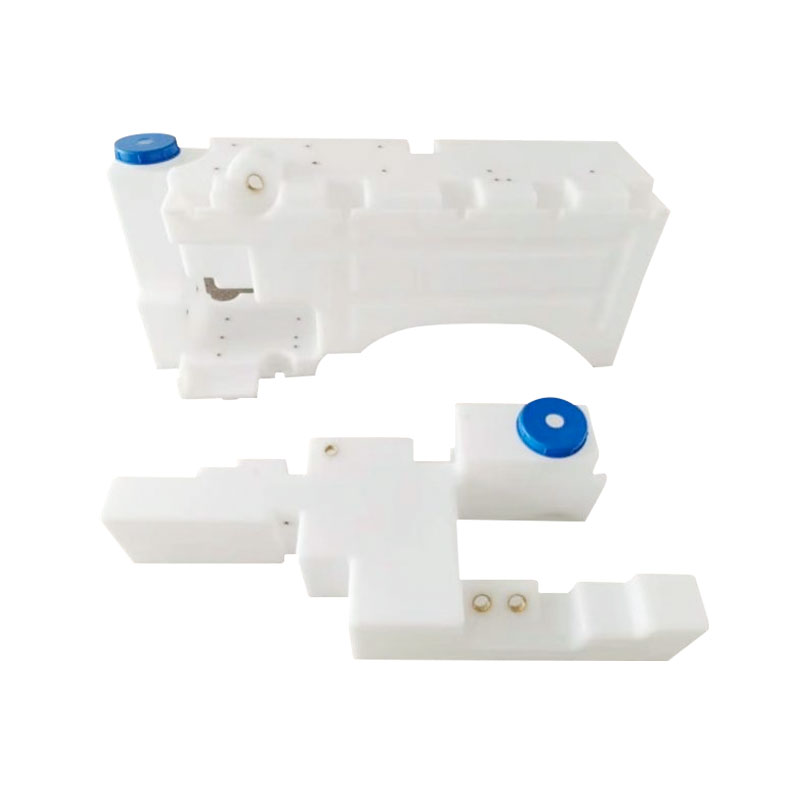
Automotive fuel storage components require strict attention to material compatibility, dimensional accuracy, structural integrity, leakage prevention, and production consistency. For manufacturers developing an automobile fuel tank mold, safety certification is not limited to the mold itself. The tooling must support a finished fuel tank that can satisfy applicable automotive regulations, material requirements, quality systems, and validation procedures. A properly engineered plastic gasoline container tooling solution therefore becomes an important foundation for safe automotive fluid tank manufacturing.
Rotational molding is particularly suitable for large, hollow fuel storage components because it can create seamless structures with relatively uniform wall distribution. The process also allows complex shapes to be integrated around available chassis space. In addition, plastic construction can reduce component weight compared with equivalent metal structures. However, these advantages only become meaningful when the tooling, material, heating process, cooling process, and inspection procedures are carefully controlled. The certification strategy should therefore begin during mold design rather than after production begins.
1. Standard rotational fuel tank molds
Standard rotational fuel tank molds are designed for conventional production environments where dimensional repeatability, reliable release, and stable thermal behavior are the primary objectives. A well-designed automobile fuel tank mold should reproduce the required tank geometry consistently while avoiding unnecessary sharp transitions that may create uneven material distribution. Venting, parting-line design, insert positioning, and mold surface quality all influence the final product.
For this category, certification normally focuses on the finished fuel tank and its production system rather than treating the mold as an independently certified safety product. Depending on the vehicle market and application, manufacturers may need to demonstrate compliance with applicable vehicle fuel-system regulations, leakage requirements, fire-resistance provisions, emissions controls, and material compatibility requirements. The mold must therefore be capable of producing samples that can pass the relevant validation tests.
The tooling is also important for automotive fluid tank manufacturing because inconsistent wall thickness or distortion can affect pressure resistance, sealing performance, mounting accuracy, and long-term durability. Zhroto Mould supports mold development from engineering review through CNC manufacturing, trial production, dimensional inspection, and delivery, helping customers establish a controlled path from product concept to production tooling.
- Suitable for conventional gas-heated rotational molding machines.
- Designed for repeatable production of large hollow automotive tanks.
- Supports complex chassis-fitting geometries and integrated structural features.
- Allows dimensional inspection and sample validation before production release.
2. High-barrier fuel tank tooling
High-barrier fuel tank tooling is intended for applications where fuel permeation, chemical compatibility, and long-term containment performance receive greater attention. The concept of high barrier rotomolding is closely connected with material selection and process control. The mold must provide stable heating characteristics so that the selected polymer system can develop the required structure without excessive degradation or unacceptable variations in wall formation.
In this category, certification and validation may include fuel permeation testing, leakage evaluation, dimensional inspection, material compatibility assessment, and durability testing according to the requirements applicable to the intended vehicle and market. plastic gasoline container tooling must therefore be developed with the complete product system in mind. Mold geometry alone cannot guarantee certification; the resin, additives, processing parameters, tank fittings, closures, and final assembly all influence compliance.
A major advantage of this category is the ability to produce complex tank shapes while maintaining a controlled manufacturing process. The rotational molding method can create seamless hollow bodies and can accommodate special geometries that make better use of limited chassis space. For manufacturers pursuing demanding automotive fluid tank manufacturing programs, Zhroto Mould can assist with product structure optimization, CAD-based mold development, precision machining, trial molding, and sample evaluation.
Certification priorities for high-barrier designs
- Confirm the target vehicle-market regulations and applicable fuel-system requirements.
- Verify polymer compatibility with the intended fuel and operating environment.
- Validate permeability, leakage resistance, dimensional stability, and structural performance.
- Document production parameters and establish repeatable quality inspection procedures.
3. Electric-heated precision fuel tank molds
Electric-heated rotational molding represents a more advanced tooling category. It provides more precise temperature management and can support independent heating zones, which is valuable when a fuel tank contains complicated contours or areas with different material-flow requirements. For an automobile fuel tank mold, improved thermal control can help manufacturers manage production consistency and reduce process variation.
Electric-heated systems can provide temperature control accuracy within approximately 1 to 2 degrees Celsius, zoned heating capability, and thermal efficiency above 95 percent under suitable operating conditions. These characteristics place greater demands on mold thermal conductivity, mold construction, temperature sensing, and process management. The objective is not simply faster heating, but more predictable material distribution and repeatable product quality.
Since 2023, Zhroto Mould has expanded its capabilities in electric-heated rotational molding technology. Its engineering approach covers mold design, CNC machining, mold trials, and production support. For demanding high barrier rotomolding applications, the combination of carefully designed tooling and controlled heating can provide a stronger foundation for validation and process stability.
| Category | Main focus | Typical advantage | Validation emphasis |
| Standard rotational mold | Reliable geometry and production | Broad equipment compatibility | Leakage and dimensional consistency |
| High-barrier tooling | Permeation and containment | Enhanced fuel-system performance | Permeation, compatibility, and durability |
| Electric-heated tooling | Thermal precision | Zoned heating and process control | Process repeatability and product validation |
Safety certification and mold development
Safety certification should be integrated into the mold-development workflow from the earliest engineering stage. A supplier should first understand the tank's dimensions, installation environment, fuel type, connection points, expected service conditions, and target market. This information determines which regulatory and validation requirements are relevant. An automobile fuel tank mold should then be optimized to support those requirements instead of being designed only around basic part geometry.
A complete development process can include project consultation, product design optimization, 3D modeling, mold design confirmation, precision CNC manufacturing, material and process recommendations, trial molding, sample validation, quality inspection, acceptance, and production support. This approach is particularly important for automotive fluid tank manufacturing, where tooling errors can propagate into repeated production defects.
Founded in 2015, Jiangsu Zhroto Mould Co., Ltd. specializes in rotational molding mold design, mold manufacturing, rotomolded product processing, and integrated technical solutions. Its modern facility in Jiangyan District, Taizhou City includes more than 12,000 square meters of standardized production workshops within an 18,000-square-meter site. The company produces more than 800 sets of molds annually and serves applications including vehicle fuel tanks, water tanks, industrial equipment, agricultural machinery, outdoor products, and other large hollow components.
Quality systems supporting certification readiness
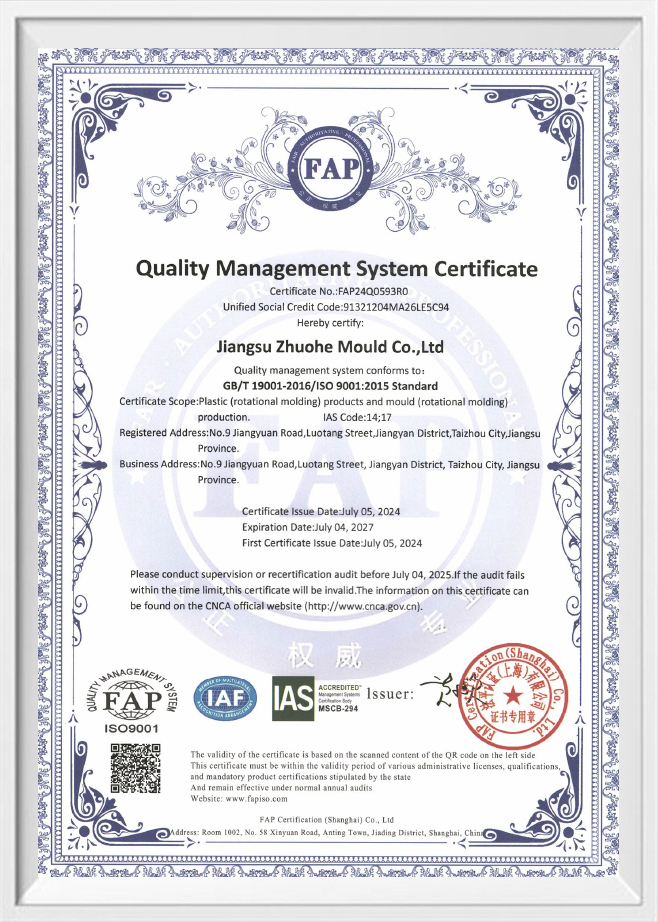
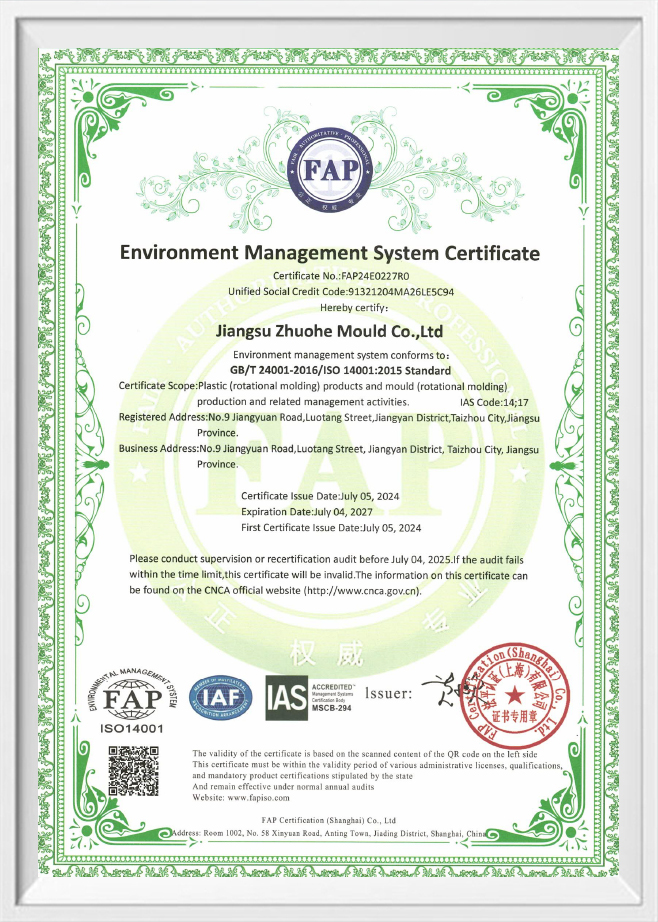
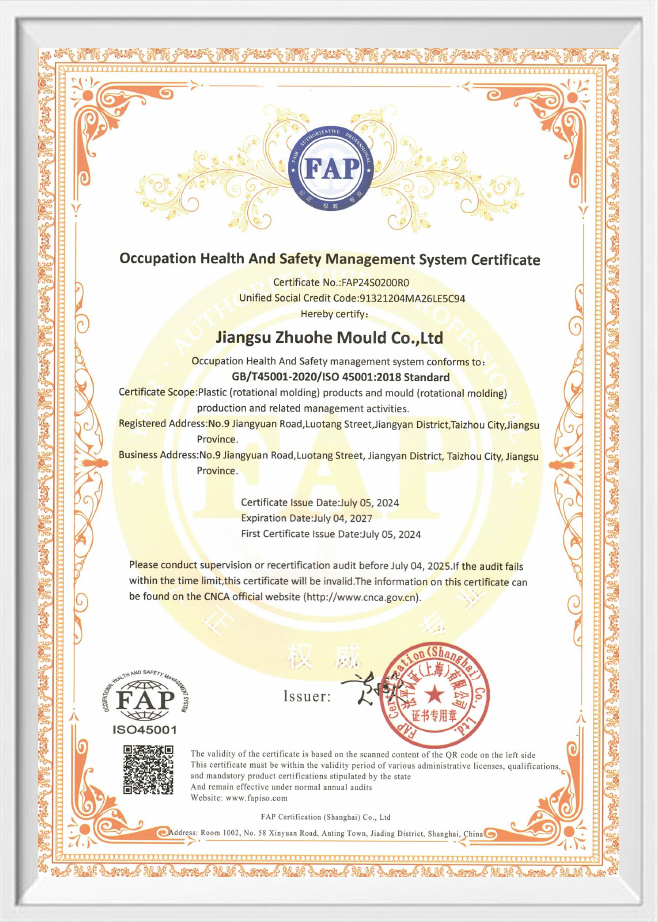
The company operates with ISO 9001:2015 Quality Management System Certification, ISO 14001:2015 Environmental Management System Certification, and ISO 45001:2015 Occupational Health and Safety Management System Certification. These certifications do not replace product-specific automotive approval, but they demonstrate structured management practices that can support consistent manufacturing and controlled documentation.
For plastic gasoline container tooling, certification readiness also depends on traceable inspection and disciplined process control. Mold acceptance should include dimensional verification, surface inspection, trial samples, and confirmation that the tooling can repeatedly manufacture parts within the customer's specifications. After delivery, production technical support and maintenance advice can further help preserve mold performance.
What manufacturers should verify before approval
The specific certification pathway varies according to vehicle type, fuel system design, geographical market, and applicable legislation. Manufacturers should not assume that a general quality certificate automatically proves fuel-tank compliance. Instead, the mold supplier, polymer supplier, tank manufacturer, and vehicle program team should coordinate their documentation and validation responsibilities.
- Applicable automotive fuel-system regulations and market requirements.
- Fuel compatibility and material documentation.
- Leakage, permeability, dimensional, and durability validation.
- Mold dimensional accuracy and repeatability.
- Heating, cooling, venting, and process-control requirements.
- Inspection records and production traceability.
A properly engineered high barrier rotomolding solution should be evaluated as part of the complete fuel-tank production system. The tooling, material, process parameters, fittings, closures, and final installation must work together. By combining precision mold manufacturing with process engineering and validation support, manufacturers can reduce development risk while preparing more effectively for product-specific safety approval.
Frequently Asked Questions
Q1: Does an automobile fuel tank mold itself require automotive certification?
Usually, the applicable safety approval is focused on the finished fuel tank and vehicle fuel system rather than the mold as an independent certified product. However, the tooling must be capable of consistently producing parts that satisfy the required validation standards.
Q2: Why is high barrier rotomolding important for fuel tanks?
high barrier rotomolding emphasizes controlled processing and suitable barrier materials to help manage fuel permeation and containment performance. The exact requirements depend on the fuel, tank construction, vehicle application, and applicable regulations.
Q3: Can plastic gasoline container tooling produce complex automotive tank shapes?
Yes. Rotational molding is well suited to complex hollow geometries and can help designers use otherwise restricted chassis space efficiently. Proper mold design is essential for maintaining consistent wall formation, dimensional accuracy, and reliable demolding.
Q4: What support does Zhroto Mould provide for fuel tank projects?
Jiangsu Zhroto Mould Co., Ltd. provides integrated support covering project evaluation, structural optimization, 3D engineering, mold manufacturing, trial molding, quality inspection, acceptance, production guidance, and mold maintenance advice. Its capabilities cover both conventional gas-heated and advanced electric-heated rotational molding systems.
Q5: What should be considered when selecting tooling for automotive fluid tank manufacturing?
Manufacturers should consider the tank geometry, polymer system, fuel compatibility, applicable regulations, mold material, thermal behavior, production equipment, dimensional tolerances, validation plan, and expected production volume. A tooling solution should be selected according to the complete product and certification pathway rather than mold cost alone.
 +86-18006248936
  ricky.t@zhroto.com
  No.9 Jiangyuan Road, Luotang Street, Jiangyan District, Taizhou City,Jiangsu Province, China