
 en
en 中文简体
中文简体 русский
 Español
 Deutsch
 Polskie
 REQUEST A QUOTE

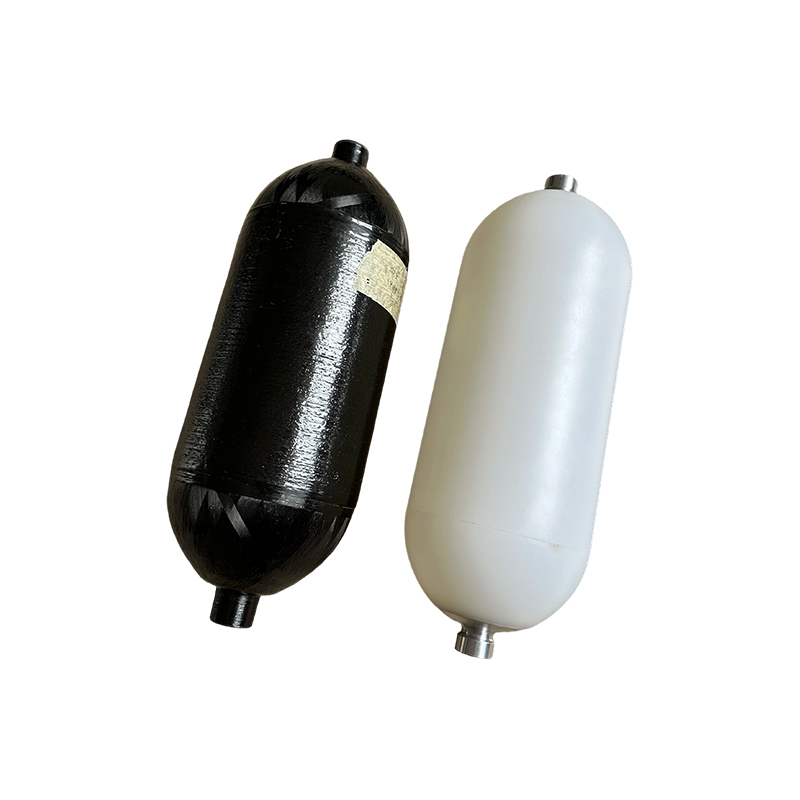
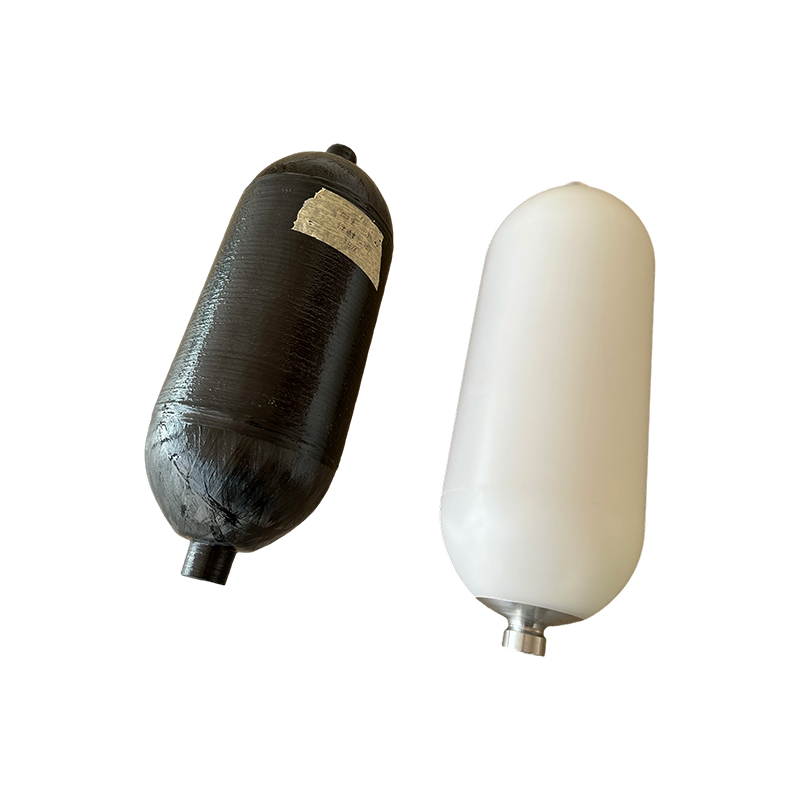
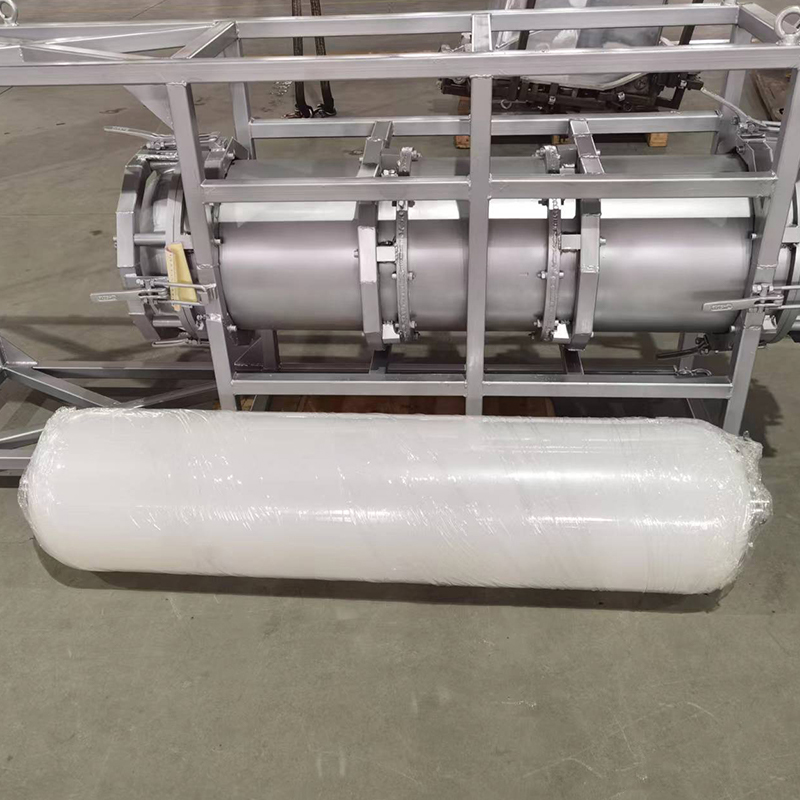
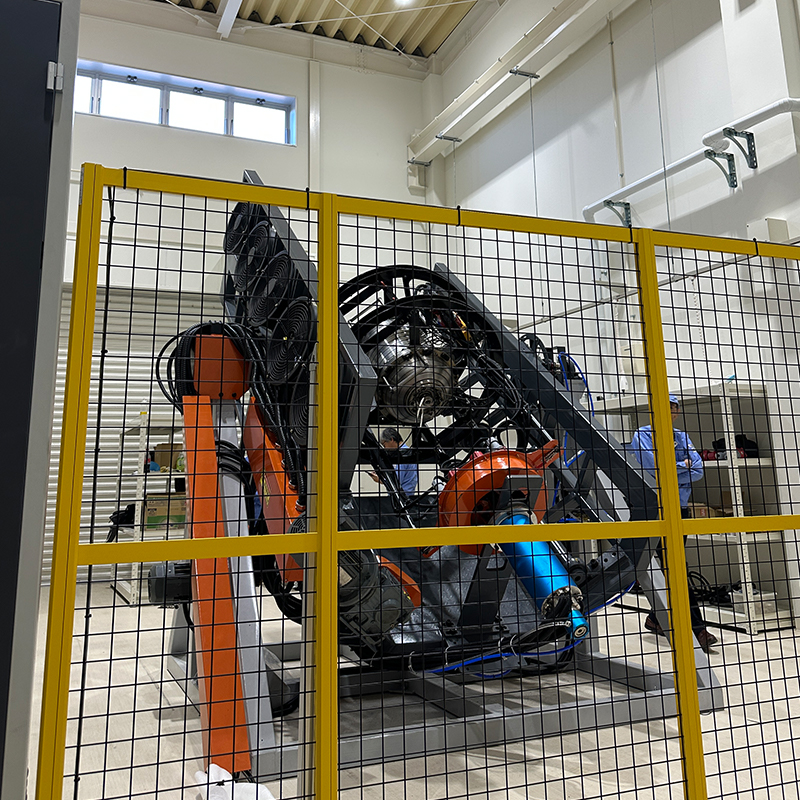
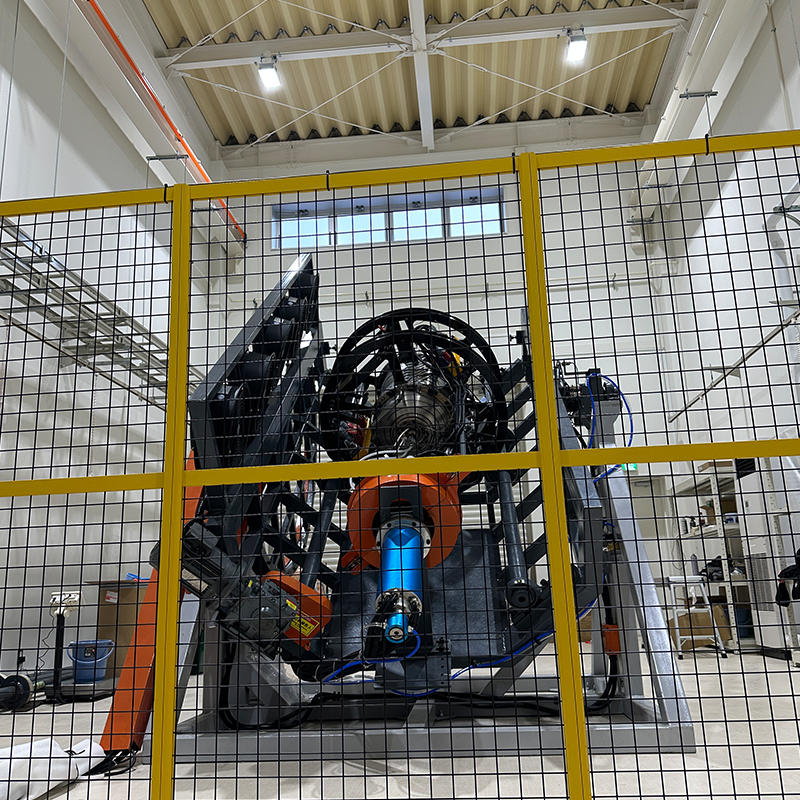

What materials are best for hydrogen gas cylinder rotational molding mold
Material selection is one of the most important decisions in designing a mold for hollow hydrogen storage products. A suitable mold must tolerate repeated heating and cooling, maintain dimensional stability, support uniform polymer distribution, and remain reliable through long production cycles. For this reason, the material used for a hydrogen gas cylinder rotational molding mold must be evaluated together with the heating method, cylinder geometry, liner material, production volume, and required surface quality.
For hydrogen-related applications, rotational molding is particularly useful when manufacturers require hollow structures, smooth internal surfaces, flexible wall design, and relatively low tooling complexity compared with some conventional molding methods. However, hydrogen containment introduces demanding requirements for liner consistency and structural reliability. The mold therefore needs to provide accurate geometry while resisting thermal deformation. The following three product categories illustrate how mold construction can be matched with different production requirements.
1. Conventional Gas-Heated Rotational Molds
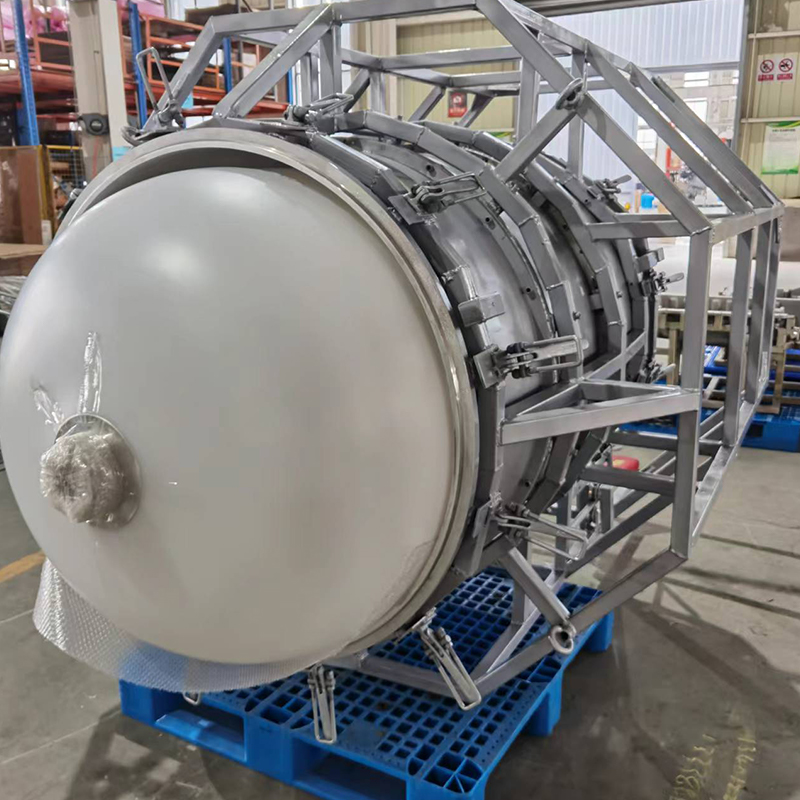
Conventional gas-heated molds are designed for rotational molding machines that use heated air or gas-based thermal systems. They are a practical choice for medium- and large-scale production because the equipment is widely established and can accommodate tanks, containers, protective shells, and other large hollow components. In this category, mold material selection focuses on thermal stability, heat transfer behavior, manufacturability, and resistance to repeated thermal cycling.
Steel and aluminum are common engineering choices, although the final selection should depend on product dimensions, heating requirements, production frequency, and surface specifications. Steel offers robust structural strength and long service life, while aluminum can provide efficient heat transfer and relatively low mold weight. For cylindrical hydrogen-related products, accurate mold closure is particularly important because deformation at the parting area can influence final dimensions and wall consistency. A well-engineered composite gas cylinder liner tooling solution therefore requires not only appropriate material but also careful control of joints, reinforcement, and machining accuracy.
The main advantage of this category is broad equipment compatibility. It is suitable for manufacturers that already operate conventional rotomolding machinery and need dependable tooling without changing their complete production system. The mold can be reinforced to withstand repeated heating and cooling cycles while maintaining a stable cavity shape. It is also suitable for outer protective shells where the primary objective is mechanical protection rather than direct exposure to stored hydrogen.
- Suitable for medium- and high-volume rotational molding production.
- Compatible with established gas-heated rotomolding equipment.
- Supports cylindrical and complex hollow geometries.
- Can be customized for different cylinder dimensions and closure configurations.
Jiangsu Zhroto Mould Co., Ltd. has extensive experience manufacturing conventional rotational molding molds for tanks, containers, industrial components, and hydrogen-related products. Its production capabilities include CNC machining of complex curved surfaces, mold trial validation, dimensional inspection, and production support, allowing material selection to be considered as part of a complete tooling solution rather than as an isolated design decision.
2. Electric-Heated Precision Rotational Molds
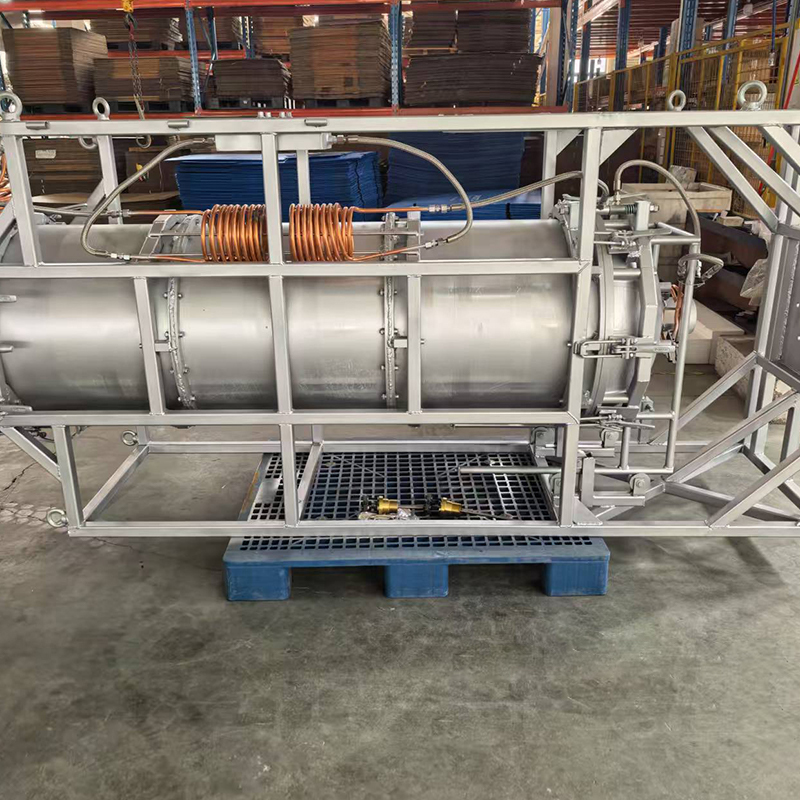
Electric-heated rotational molds are developed for modern equipment that requires more controlled thermal management. Since 2023, ZHROTO has invested in electric-heating rotomolding technology, with an emphasis on precise temperature management and zoned heating. In this category, the mold must work effectively with controlled heat input, making thermal conductivity and heat distribution especially important.
An electric heating rotomold technology solution can provide more precise process management than conventional heating, particularly when a product has varying wall sections or geometrically sensitive areas. The mold material must therefore support predictable heat transfer and stable dimensions during repeated cycles. Aluminum is often attractive where rapid and relatively uniform heat transfer is important, while engineered steel solutions can be selected when greater structural rigidity and durability are required.
The key difference from conventional gas-heated molds is the closer relationship between mold construction and thermal control. A precision tooling system should support localized heating requirements without creating significant distortion. This is particularly valuable for hydrogen storage liners, where consistent wall thickness and reduced internal defects can contribute to improved product reliability. The supplied mold design is compatible with automated and semi-automated production lines, making it suitable for manufacturers seeking repeatable production conditions.
For demanding applications, precision temperature control tooling can help manufacturers establish more stable processing conditions. ZHROTO's electric-heated mold capabilities are designed around temperature control accuracy of approximately 1 to 2 degrees Celsius, independent zoned heating, high thermal efficiency, and potential energy reductions compared with conventional processes. These characteristics make electric-heated tooling particularly suitable where process consistency is more important than simply minimizing initial tooling cost.
| Feature | Gas-Heated Mold | Electric-Heated Mold | Custom Prototype Mold |
| Primary focus | Broad compatibility | Thermal precision | Design validation |
| Typical production | Medium to high volume | Automated and controlled production | Prototype to small batch |
| Material emphasis | Strength and durability | Thermal response and stability | Flexibility and manufacturability |
| Typical application | Shells and containers | Controlled liner production | New hydrogen vessel concepts |
3. Custom Prototype and Composite Liner Molds
Custom prototype molds are intended for new hydrogen storage concepts, experimental vessels, and specialized protective structures. Their purpose differs from production tooling because design flexibility and rapid validation can be more important than maximum production speed. A prototype mold must still provide stable geometry, smooth internal surfaces, reliable closure, and sufficient durability for repeated testing.
For this category, the material should be selected according to the expected number of trials and the final product geometry. Aluminum can be advantageous when machining speed, heat transfer, and mold weight are important. Steel may be preferable when the prototype is expected to transition quickly into repeated production. In either case, accurate CNC machining is essential because even small dimensional deviations can influence cylinder volume, wall distribution, assembly interfaces, and downstream testing.
A specialized alternative energy storage liner requires particularly careful consideration of material compatibility. The supplied mold design supports HDPE, cross-linked polyethylene, and other rotomolding-grade polymers commonly considered for liner and protective-shell applications. The mold itself should not introduce unnecessary surface defects or dimensional instability during processing. Smooth cavity surfaces and reliable mold closure are therefore important design characteristics.
This category is different from standard production tooling because it can be developed around a customer's drawings, product concepts, or revised geometry. The engineering workflow can include product design optimization, three-dimensional CAD modeling, mold design confirmation, precision CNC manufacturing, trial production, sample validation, inspection, and final delivery. For composite hydrogen tank projects, high pressure hydrogen tank manufacturing demands close cooperation between product design and tooling development so that the mold supports the intended liner architecture and production process.
- Review the cylinder application, dimensions, wall structure, and production objectives.
- Optimize the product geometry for rotational molding and material distribution.
- Select the mold construction material according to thermal and mechanical requirements.
- Complete CAD development, CNC machining, mold assembly, and trial validation.
- Inspect samples and refine the tooling before production acceptance.
Selecting Mold Material According to Production Requirements
There is no universal mold material that is ideal for every hydrogen cylinder application. The correct choice depends on cylinder size, polymer type, heating technology, production frequency, dimensional tolerance, and maintenance expectations. Aluminum can be attractive for applications requiring efficient heat transfer and manageable mold weight. Steel is often considered where greater structural rigidity, repeated cycling, and long service life are priorities. The mold design should also account for reinforcement, parting lines, lifting arrangements, fastening systems, and machining accessibility.
For manufacturers developing new hydrogen storage products, tooling decisions should be made before final product geometry is frozen. This allows the mold structure, material, heating method, and production process to be considered together. ZHROTO provides integrated services covering engineering development, material and process recommendations, precision mold manufacturing, trial testing, inspection, delivery, and ongoing technical support. The company operates an 18,000-square-meter site with more than 12,000 square meters of standardized workshops and an annual mold output exceeding 800 sets.
Quality, Safety, and Long-Term Tooling Performance
Hydrogen-related products require disciplined manufacturing because the final component must maintain reliable dimensions and structural consistency throughout its intended service conditions. Although the mold is not itself the pressure-retaining component, its accuracy directly influences the quality of the molded liner or shell. Uniform material distribution, stable cavity geometry, and minimized molding defects are therefore fundamental tooling objectives.
The mold should also be designed for maintenance. Regular inspection of closure surfaces, fasteners, reinforcement areas, and cavity condition can help maintain dimensional accuracy over extended production cycles. A robust mold structure reduces the likelihood of deformation caused by repeated thermal exposure and supports consistent production results.
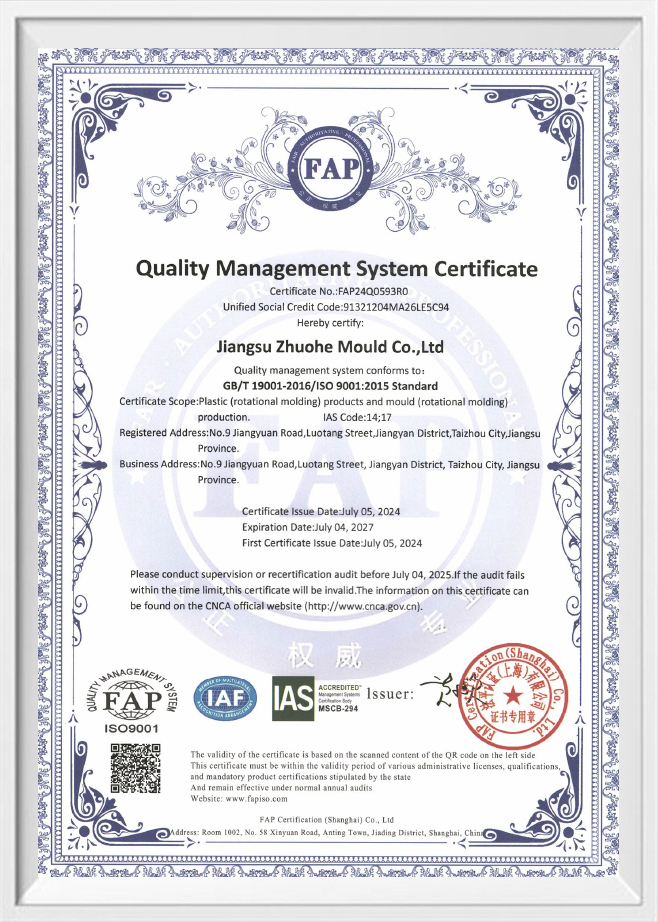
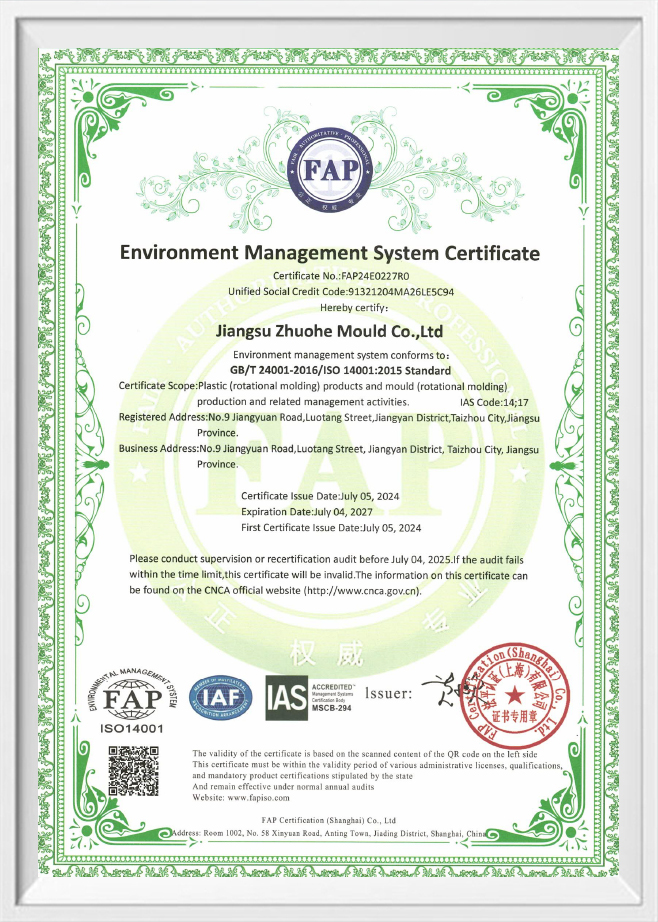
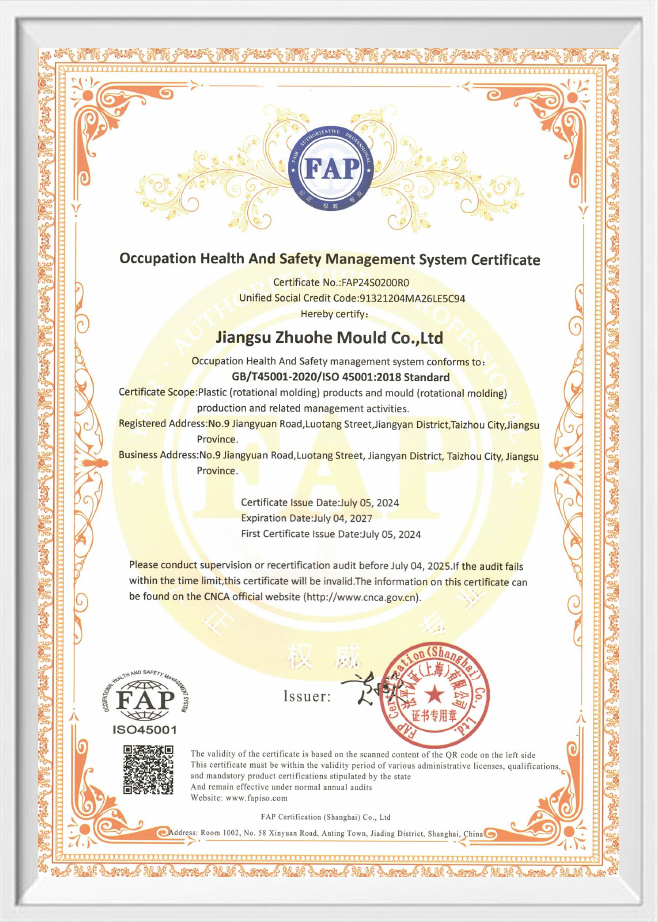
Jiangsu Zhroto Mould Co., Ltd. has obtained ISO 9001:2015, ISO 14001:2015, and ISO 45001:2018 management system certifications. Its development process covers consultation, design optimization, engineering modeling, mold confirmation, precision manufacturing, trial validation, quality inspection, delivery, production support, and maintenance advice. This integrated approach is valuable when hydrogen cylinder tooling must be customized to specific materials and production equipment.
Frequently Asked Questions
Q1: What material is generally suitable for hydrogen cylinder rotational molding molds?
Aluminum and steel are practical choices, but the best option depends on heating technology, product dimensions, production volume, thermal requirements, and expected mold life. Material selection should be made together with the complete tooling design.
Q2: Can the mold support composite hydrogen tank liner production?
Yes. The tooling can be designed for rotationally molded polymer liners and protective shells, including applications associated with composite gas cylinder liner tooling. Product geometry, polymer selection, and heating conditions should be reviewed before final mold construction.
Q3: What is the advantage of electric-heated rotational molding?
Electric heating provides more precise thermal management and can support independent heating zones. It is particularly useful when uniform processing conditions and repeatable wall distribution are important for hydrogen-related components.
Q4: Can the tooling be customized for new hydrogen storage designs?
Yes. Custom development can begin with a product concept, engineering drawing, or existing three-dimensional model. The tooling team can optimize geometry, select an appropriate mold construction, manufacture the tooling, conduct sample trials, and provide production support.
Q5: Why is mold accuracy important for hydrogen storage liners?
Accurate tooling helps maintain consistent product dimensions, wall distribution, surface quality, and structural repeatability. These factors are important when rotationally molded liners or shells are incorporated into demanding hydrogen storage systems.
Choosing the best mold material is ultimately a process-engineering decision rather than a simple material comparison. A successful solution balances thermal performance, structural stability, machining accuracy, service life, polymer compatibility, and production efficiency. By combining conventional gas-heated tooling, advanced electric-heated molds, and customized prototype solutions, manufacturers can select a tooling configuration suited to the specific requirements of hydrogen storage and transportation applications.
 +86-18006248936
  ricky.t@zhroto.com
  No.9 Jiangyuan Road, Luotang Street, Jiangyan District, Taizhou City,Jiangsu Province, China