
 en
en 中文简体
中文简体 русский
 Español
 Deutsch
 Polskie
 REQUEST A QUOTE



What makes a high quality industrial cleaning mold
Industrial cleaning equipment operates in demanding environments where containers, housings, tanks, and other plastic components may be exposed to chemicals, moisture, impact, repeated handling, and outdoor conditions. For this reason, mold quality directly affects product consistency, dimensional accuracy, service life, and manufacturing efficiency. A high-quality industrial cleaning mold must therefore be designed around both the final product and the rotational molding process. Seamless hollow construction, balanced wall distribution, reliable mold release, and stable thermal performance are essential considerations.
Rotational molding is particularly suitable for large hollow products because it can produce strong structures without weld seams. Sand-cast aluminum molds provide an effective solution for applications requiring practical mold construction, good surface quality, and efficient heat transfer. When these characteristics are combined with professional engineering and process validation, manufacturers can obtain durable products while maintaining consistent production performance.
1. Rotomolded Tank Molds for Cleaning and Storage Systems
A tank mold is designed to create large hollow containers used for storing, transporting, or processing liquids and materials. In industrial cleaning applications, tanks may serve as chemical-resistant washing vessels, wastewater collection units, mobile cleaning containers, or process-support equipment. The primary requirement is not simply a large cavity but a mold structure capable of producing uniform walls, smooth surfaces, and dependable connections. A well-engineered rotomolded tank mold supports seamless production and reduces potential weak points associated with fabricated assemblies.
Sand-cast aluminum is particularly useful for this category because it can provide a relatively smooth molding surface while allowing efficient heating and cooling during production. The raw polymer can soften and distribute evenly inside the mold as the mold rotates, helping form a consistent hollow structure. Surface quality is also important for cleaning equipment because smoother internal surfaces can reduce material accumulation and simplify routine maintenance. A high-quality industrial cleaning mold should consequently consider drainage areas, access openings, reinforcing structures, mounting points, and cleaning requirements during the initial design stage.
Compared with smaller component molds, tank molds place greater demands on large-scale machining, structural stability, and thermal management. Jiangsu Zhroto Mould Co., Ltd. has developed capabilities for large rotational molding applications, including tanks and other large hollow products. Its engineering workflow covers product evaluation, three-dimensional modeling, mold design confirmation, precision manufacturing, mold testing, sample validation, and final inspection.
- Suitable for large hollow tanks, cleaning vessels, water tanks, and industrial containers.
- Supports seamless construction with reduced dependence on welded joints.
- Can be developed with smooth surfaces that facilitate cleaning and contamination control.
- Can be adapted to conventional gas-heated or modern electric-heated rotational molding equipment.
2. Heavy-Duty Plastic Container Tooling
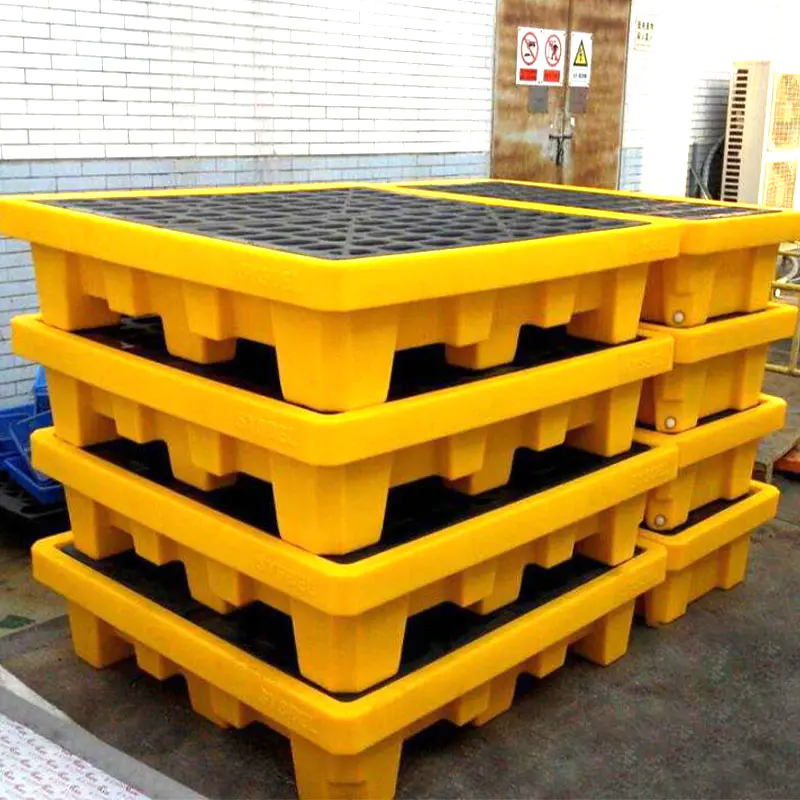
Heavy-duty containers require tooling that can repeatedly produce robust walls, reinforced corners, functional openings, and stable dimensional features. Typical applications include industrial cleaning bins, spill-control containers, waste handling products, material transport boxes, and large anti-leak pallets. The mold must withstand repeated heating, cooling, opening, closing, and handling while maintaining its intended geometry. heavy duty plastic container tooling is therefore differentiated from lighter-duty consumer product tooling by its emphasis on structural reliability and long-term production stability.
The product construction described for large industrial anti-leak pallets demonstrates the value of sand-cast aluminum rotational molding molds. These molds can efficiently distribute softened material across the cavity while supporting smooth and relatively uniform surfaces. For containment products, surface quality has a practical function: a flatter, smoother surface can help limit leakage paths and make the product easier to inspect and clean. Proper mold design must also account for corners, ribs, handles, stacking areas, and other features that influence product strength.
Compared with tank tooling, container tooling generally places greater emphasis on repeated impact, handling convenience, stacking stability, and localized reinforcement. Jiangsu Zhroto Mould Co., Ltd. provides integrated mold and finished-product support, allowing product concepts and existing drawings to be evaluated before mold development begins. This approach helps identify manufacturability issues early and improves coordination between product geometry and rotational molding requirements.
The following comparison illustrates how different mold categories can serve industrial cleaning and related applications:
| Mold category | Main application | Primary design focus | Typical advantage |
| Tank mold | Storage and cleaning vessels | Wall uniformity and structural integrity | Large seamless hollow products |
| Heavy-duty container tooling | Bins, pallets, and handling containers | Impact resistance and reinforcement | Durability during repeated handling |
| Machine housing mold | Industrial equipment enclosures | Dimensional precision and integration | Protection with lightweight construction |
3. Machine Housing Mold Production for Industrial Equipment
Industrial machines often require protective housings that shield internal components from dust, moisture, accidental contact, and environmental exposure. Unlike tanks and containers, housings must often accommodate mounting points, ventilation areas, access doors, control interfaces, and complex curved surfaces. machine housing mold production therefore requires careful attention to dimensional accuracy and the relationship between the mold cavity and the final assembly.
Rotational molding can be advantageous for larger equipment housings because it allows relatively complex hollow structures to be produced with fewer assembled parts. The absence of seams in major sections can improve visual consistency and simplify product construction. For these applications, durable farm mold design and other heavy-use mold engineering principles can also be applied when housings are intended for agricultural machinery or outdoor equipment. Mold quality should include suitable corner transitions, controlled wall distribution, reliable mounting features, and a surface finish appropriate for the operating environment.
Zhroto Mould combines CAD-based three-dimensional engineering, CNC machining, prototype validation, and production support to address these requirements. Since 2023, the company has also invested in electric-heated rotational molding capabilities. Electric heating can provide more precise temperature management and independent heating zones, increasing the importance of mold thermal performance and engineering accuracy. This capability is valuable when manufacturers need tighter process control or more demanding production consistency.
- Evaluate product dimensions, operating environment, structural requirements, and production volume.
- Optimize product geometry for rotational molding, including wall distribution, corners, openings, and reinforcement.
- Develop the three-dimensional mold model and confirm the tooling structure before machining.
- Manufacture the mold with appropriate machining methods and conduct trial production.
- Inspect samples, verify dimensional accuracy, and provide production and maintenance recommendations.
How to Evaluate Mold Quality Before Production
A high-quality mold should be evaluated beyond its initial appearance. Engineering teams should examine whether the mold supports reliable material distribution, practical demolding, stable thermal behavior, and repeatable production. Mold construction should correspond to the intended machine type and heating method. For large products, machining accuracy and structural rigidity become particularly important because minor design inconsistencies can become more noticeable across a large surface.
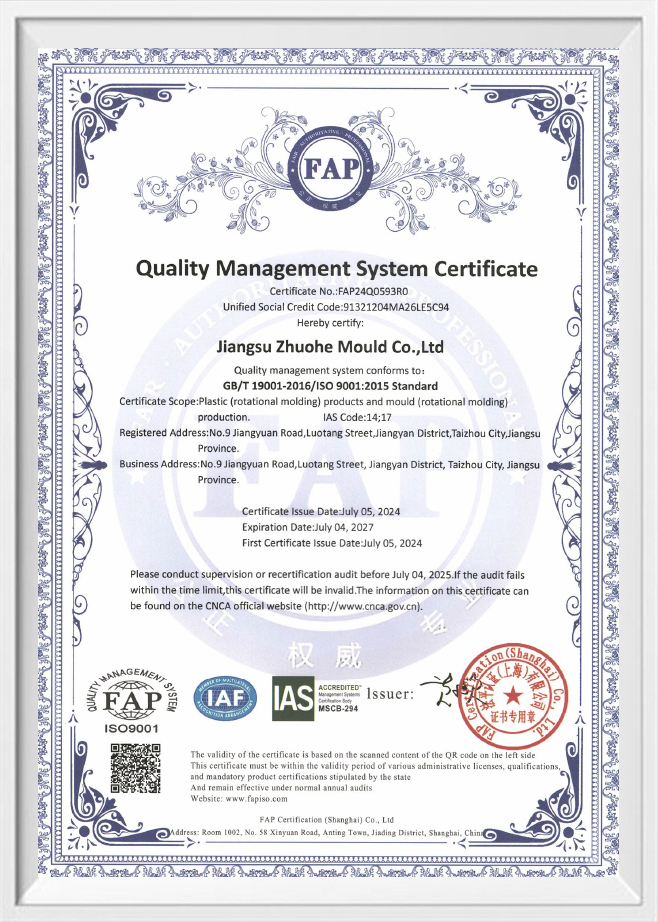
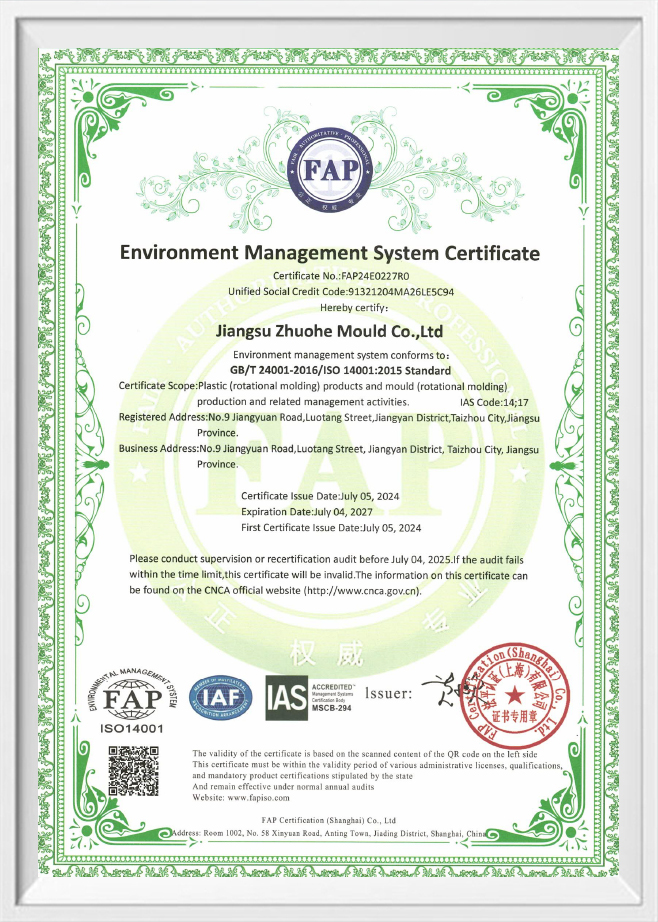
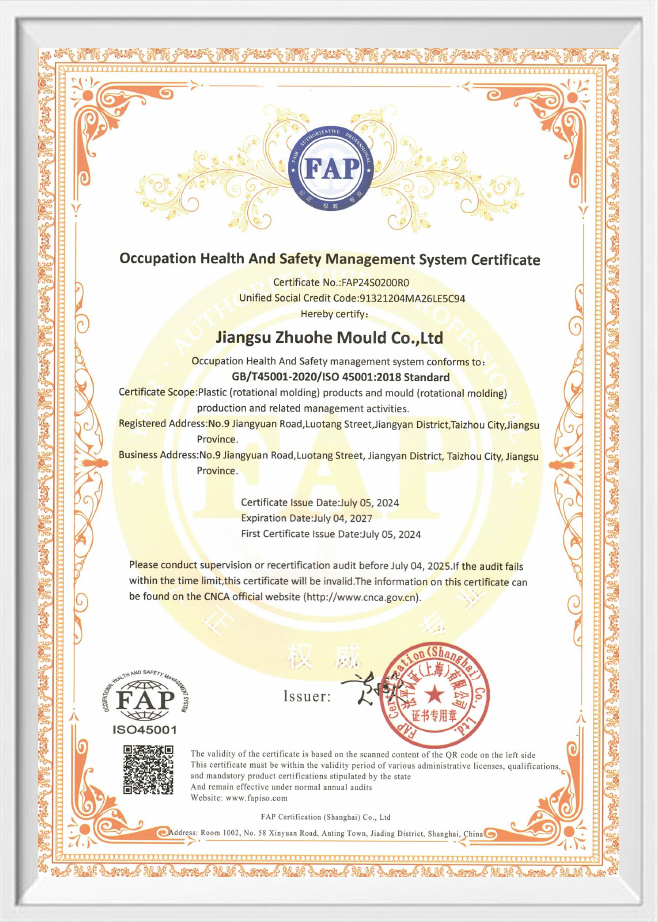
Quality inspection should also include trial production and sample validation rather than relying only on dimensional checks of the mold itself. The final product must demonstrate acceptable surface quality, geometry, functional performance, and repeatability. Jiangsu Zhroto Mould Co., Ltd. follows a development workflow extending from project consultation and product optimization through mold acceptance and ongoing technical support. The company has an annual production capacity exceeding 800 mold sets and maintains ISO 9001:2015, ISO 14001:2015, and ISO 45001:2015 management system certifications.
For manufacturers, the most reliable approach is to treat mold design as part of the complete production system rather than as an isolated tooling purchase. Material recommendations, machine compatibility, heating strategy, sample testing, and future maintenance should all be considered before final approval. This integrated approach can improve mold service life while reducing production instability and unnecessary tooling modifications.
Frequently Asked Questions
Q1: What makes a high-quality industrial cleaning mold?
A high-quality mold combines accurate geometry, appropriate aluminum construction, good surface quality, stable thermal behavior, reliable demolding, and compatibility with the intended rotational molding machine. Product requirements should determine the mold structure rather than using a one-size-fits-all design.
Q2: When should a rotomolded tank mold be selected?
A tank mold is suitable when the product requires a large seamless hollow structure for liquid storage, cleaning operations, water handling, or industrial processing. Its design should account for openings, drainage, reinforcement, wall distribution, and cleaning requirements.
Q3: Why is heavy-duty container tooling important for industrial applications?
Industrial containers often experience repeated impact, lifting, stacking, and exposure to demanding environments. Appropriate tooling helps create reinforced corners, stable walls, and functional surfaces while supporting consistent production over repeated molding cycles.
Q4: Can Zhroto Mould provide customized rotational molding solutions?
Yes. Zhroto Mould provides services covering project evaluation, product design optimization, 3D modeling, mold manufacturing, trial production, quality inspection, delivery, and production support. Its capabilities cover conventional gas-heated equipment as well as electric-heated rotational molding systems.
Q5: What should manufacturers consider before ordering machine housing tooling?
Manufacturers should define the housing dimensions, environmental conditions, mounting features, access requirements, production volume, machine compatibility, and desired surface quality. Early engineering review can help ensure that the final mold supports both product performance and efficient manufacturing.
 +86-18006248936
  ricky.t@zhroto.com
  No.9 Jiangyuan Road, Luotang Street, Jiangyan District, Taizhou City,Jiangsu Province, China