
 English
 中文简体
中文简体 русский
 Español
Military box mold


 [email protected]
 +86-18006248936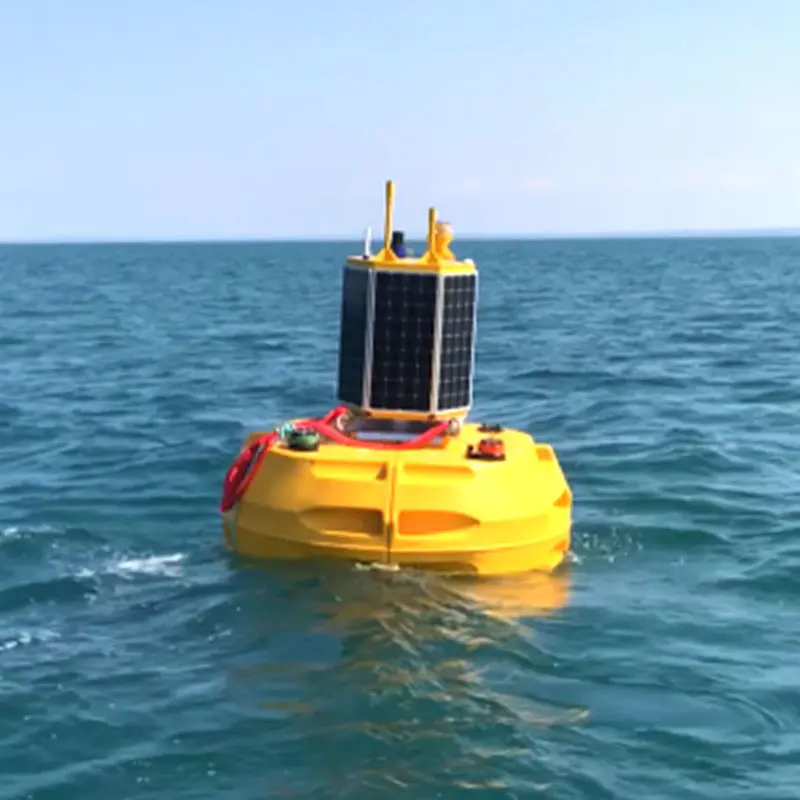

Navigation mark buoy mold is a tool or equipment used to manufacture navigation mark buoyancy body. Navigation buoys are floating facilities used in oceans, rivers, lakes, and other waters to mark waterways, provide water depth information, and guide ships to navigate safely. The design of the mold must ensure that the navigation mark buoyant body has sufficient buoyancy. The size of the buoyancy is directly related to whether the floating body can carry the required marking equipment and remain on the water. The mold will also pay special attention to the stability of the floating body. In waters with strong waves, the floating body must be able to remain stable and avoid tilting or rolling to ensure the accuracy of its indicating function. Rotational molds can be composed of two or more pieces, with no restrictions on shape and size, so products with complex shapes can be produced. This provides great flexibility in the design of navigation buoys to meet the needs of different waters and environments.
We understand that privacy protection is crucial for our clients and we take it seriously. Weare committed to protecting your privacy and ensuring your personal information and
business details are kept confidential.
Rest assured that your personal information and business details will never be shared withany third party without your express consent We will only use your information for thepurposes of providing you with our services and fulfilling our contractual obligations to you.
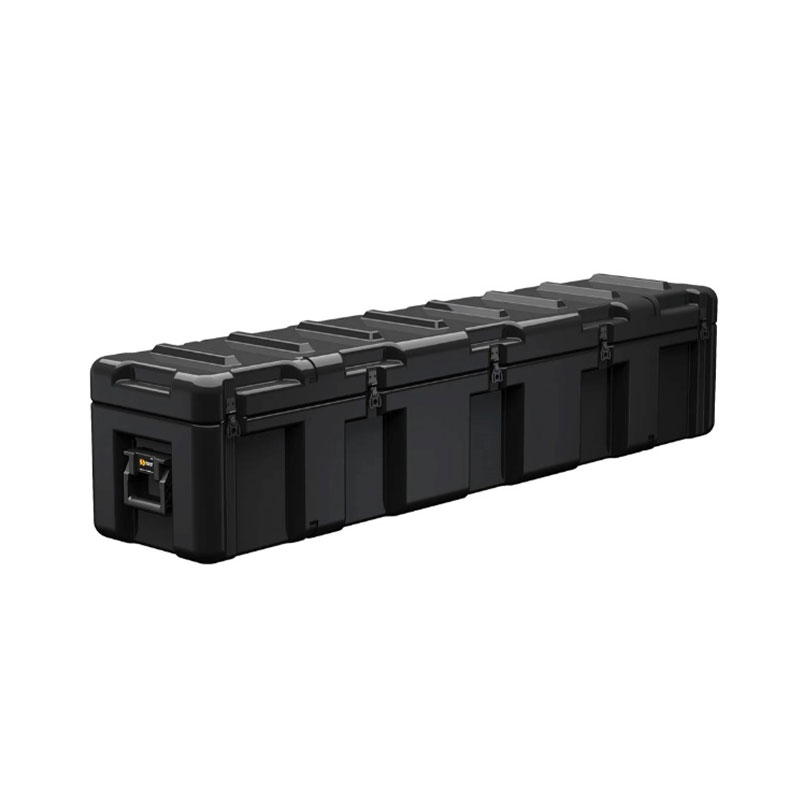
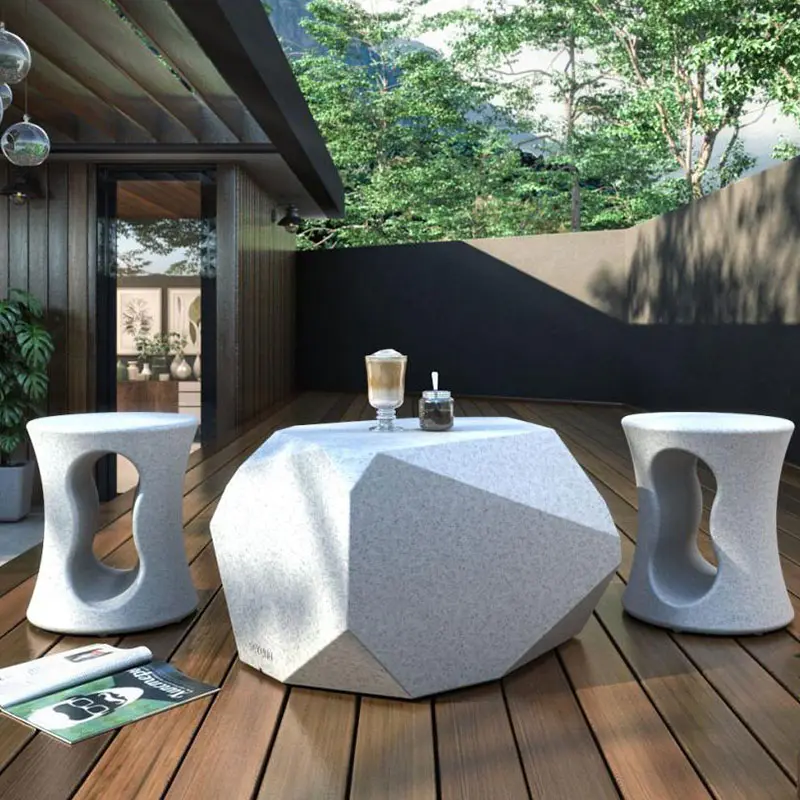
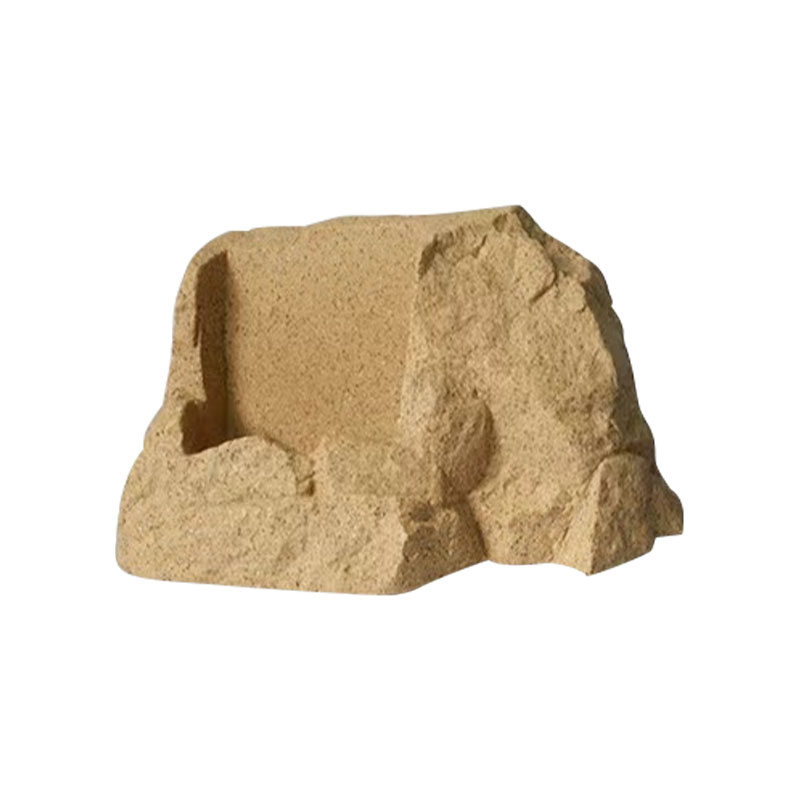
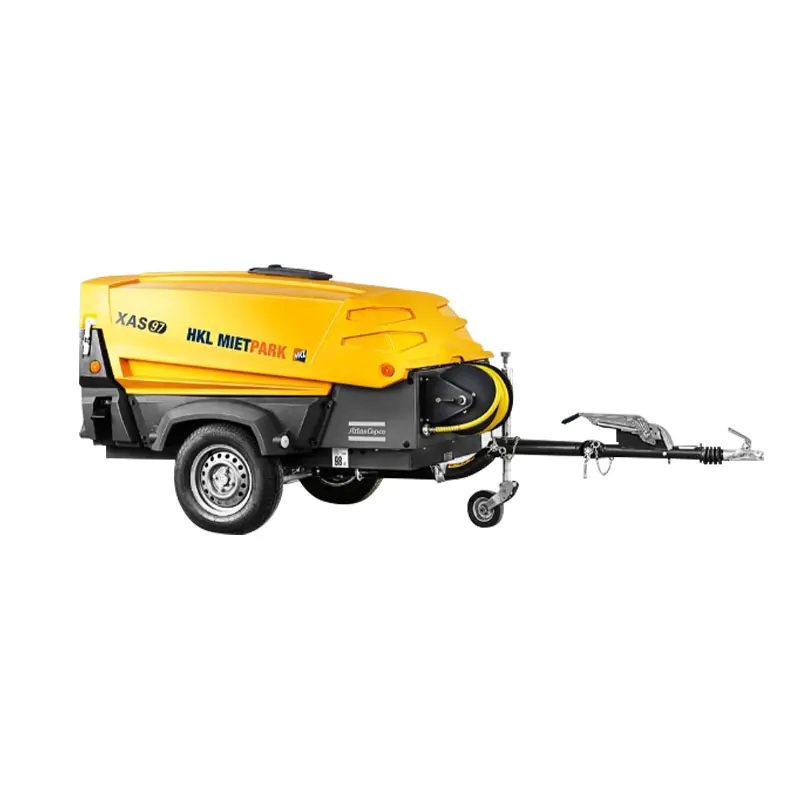
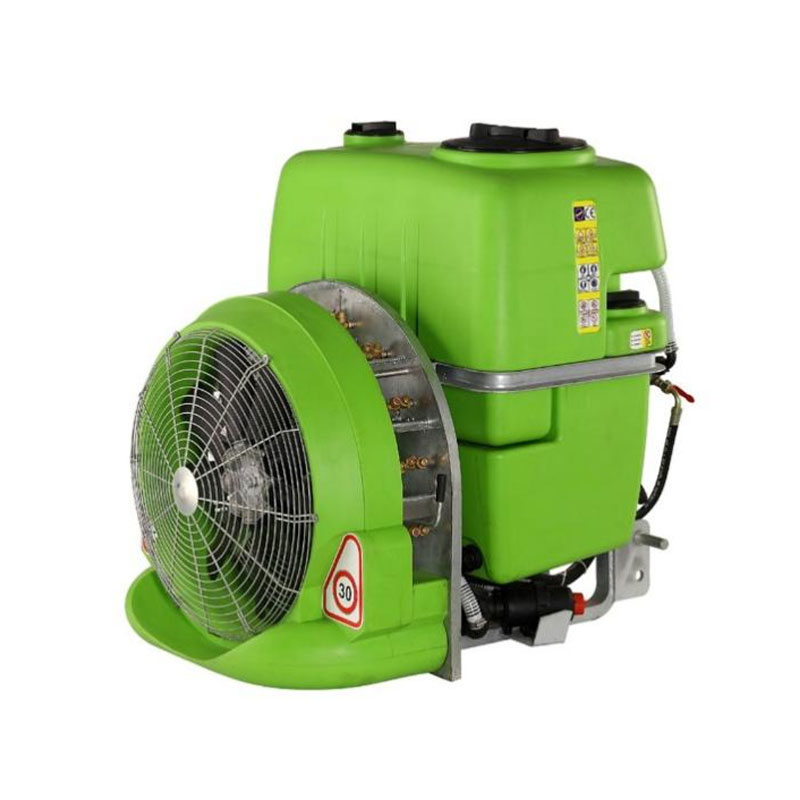
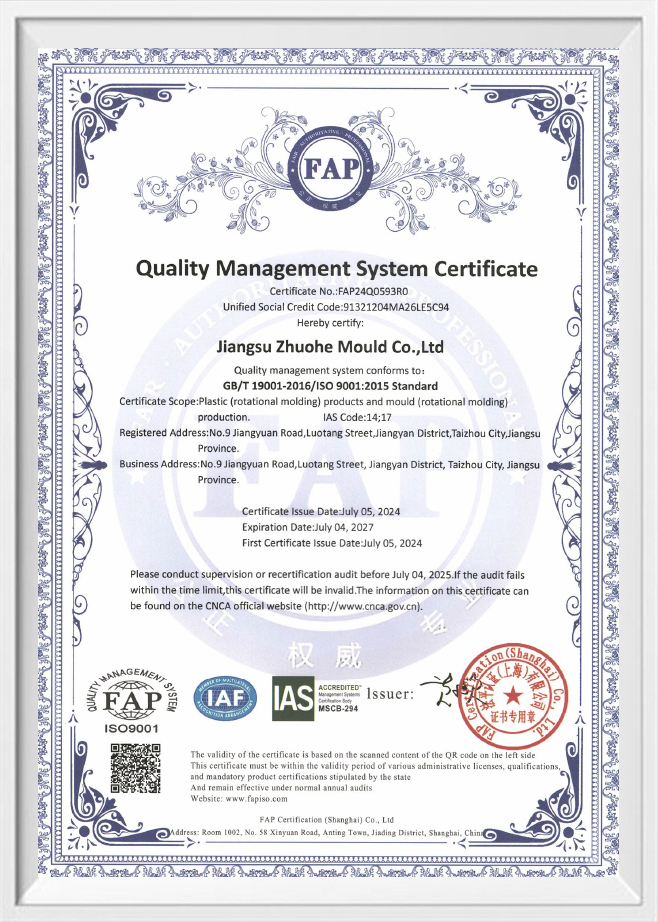
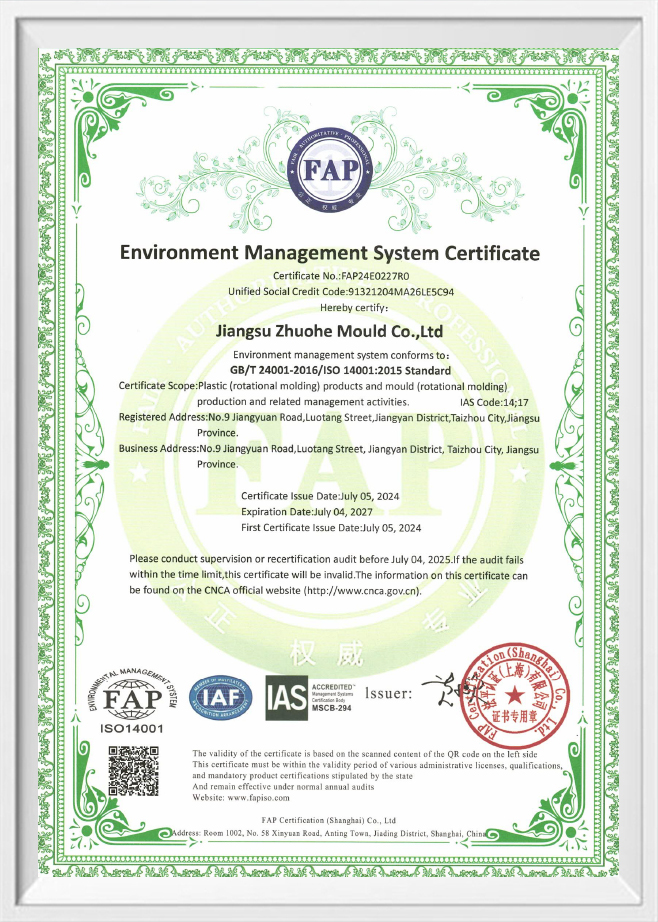
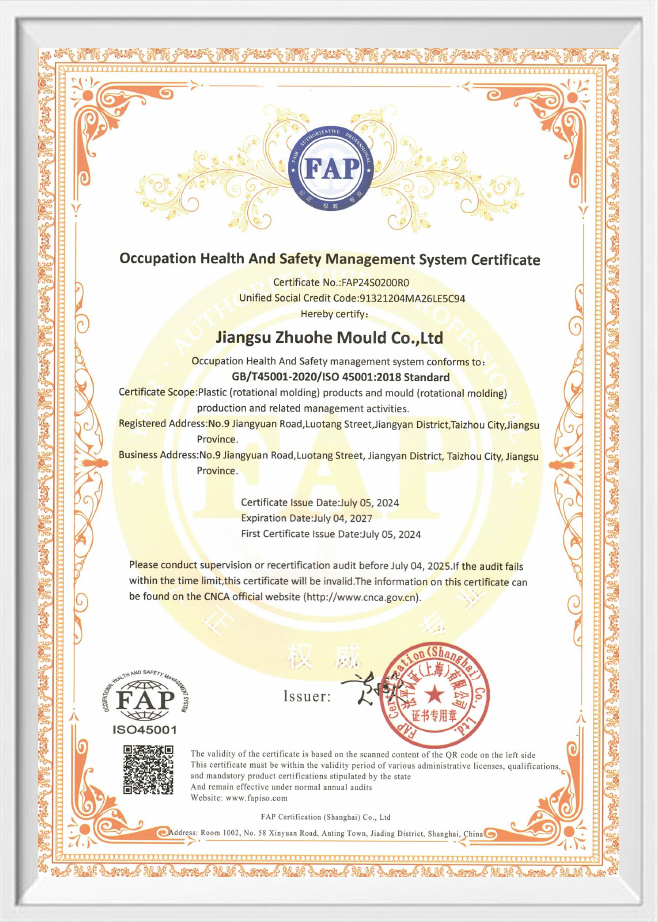
ZHROTO isChina Custom Navigation buoy mold Manufacturers and Navigation buoy mold Suppliers, founded in 2015 (formerly Suzhou Zhuohe Mould Technology Co., LTD.) moved to Taizhou City, Jiangyan District in December 2021, New name - Jiangsu Zhuohe Mould Co., LTD., with years of experience in the development and production of roto molding molds & parts, the company team participated in the 2008 Beijing Olympic Games and 2010 Shanghai World Expo. Skilled roto molding for engineering vehicle fuel/water tanks, cleaning environmental tanks, toy furniture, kayaking, buoy floating, agricultural machinery accessories, coolers, etc. The new factory plant covers an area of more than 12000 square meters, with 10 CNC centers, including one set of five-axis CNC centers, 1 set of 4mtrs rotational molding machine, 2 sets of 3.5mtrs rotational molding machines and 1 set of 3mtrs 3arms. The annual capacity of mold making is about 1500 sets and rotomoulding plastic products is more than 3600 tons. The company has passed ISO9001:2015 Quality management certification, ISO14001:2015 Environmental management certification, and ISO45001:2015 Occupational Health and Safety Management certification system. We offer Navigation buoy mold .
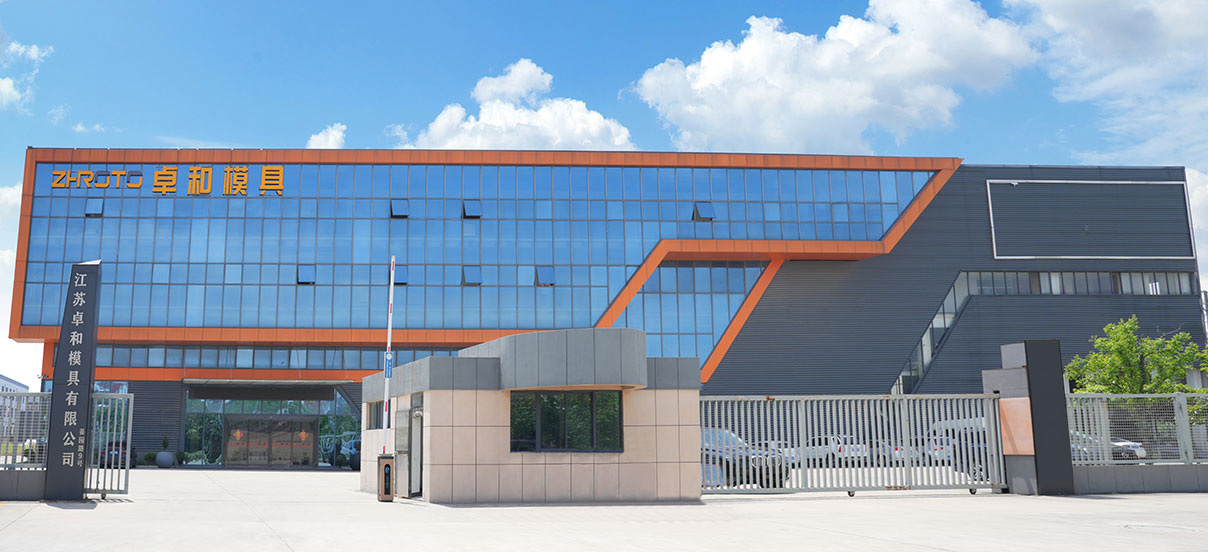
The company has passed ISO9001:2015 Quality Management Certification, ISO14001:2015 Environmental Management Certification, and ISO45001:2015 Occupational Health and Safety Management Certification System.
In the production of modern sports products, the sports equipment rotational mold plays a crucial role in creating lightweight, durable, and precisely shaped components. Whether used for manufacturing...
In modern livestock farming, durable and hygienic plastic products play a critical role in ensuring animal welfare, productivity, and ease of maintenance. One manufacturing technology that has become ...
The barricade rotational mold process is a widely used manufacturing method for producing durable, lightweight, and uniform plastic barricades utilized in traffic management, construction zones, and p...
In the vast ocean, winding rivers and quiet and deep lakes, navigation buoys are like invisible lighthouses, silently guarding the safe navigation of every ship. These seemingly simple floating facilities actually carry multiple tasks such as navigation positioning, water depth marking and navigation guidance, which are inseparable from the support and shaping of precision moulds. Jiangsu Zhuohe Mould Co., Ltd., as a leading manufacturer of navigation buoy moulds in the industry, is escorting maritime safety with its excellent technical strength and rigorous quality control system.
Ingenuity design ensures that buoyancy and safety are equally important
Jiangsu Zhuohe knows that the performance of navigation buoys is directly related to the safety and efficiency of ship navigation. Therefore, in terms of mould design, the company strictly follows the principles of marine engineering to ensure that the buoy mould can produce a buoy with sufficient buoyancy. The size of the buoyancy not only determines whether the buoy can carry heavy marking equipment, but also directly affects the stability of the buoy in a complex water environment. Through precise calculations and repeated tests, Zhuohe Mould ensures that each buoy can be as stable as a rock on the water surface, and can maintain a stable posture and accurately guide the direction even in the face of strong winds and waves.
Flexible innovation to meet diverse needs
Facing the diverse needs of different water environments, Jiangsu Zhuohe Mould has demonstrated strong innovation capabilities. The application of rotational mould technology makes the mould design no longer limited to shape and size, and can easily cope with the production of buoys with various complex structures. The application of this technology not only improves production efficiency, but also provides unlimited possibilities for buoy design, meeting the navigation needs of various waters from shallow sea to deep sea, from inland rivers to open sea. Zhuohe Mould, with its flexible customization capabilities, contributes a steady stream of innovative power to the cause of maritime safety.
Strict quality control, casting the foundation of quality
While pursuing excellent performance, Jiangsu Zhuohe Mould has equally strict requirements on product quality. From the source of steel procurement, to standardized inspection of parts, material process control, and all-round inspection of finished moulds, the company has established a complete quality management system. Every process is carefully controlled, and every detail strives for perfection to ensure that every mold can meet the highest manufacturing standards. This unremitting pursuit of quality is the key to Zhuohe Mould's ability to stand out in the fierce market competition.
Jiangsu Zhuohe Mould Co., Ltd., as a leader in the field of navigation buoy mould manufacturing, is constantly promoting the development of navigation safety with its outstanding technical strength, flexible innovation ability and strict quality control. In the future, Zhuohe Mould will continue to uphold the spirit of craftsmanship and be committed to providing more safe, efficient and reliable navigation buoy solutions for the global navigation field, and jointly protect the navigation safety of every water area.

No. 9 Jiangyuan Road, Luotang Street, Jiangyan District, Taizhou City, Jiangsu Province, China
+86-18006248936
Copyright © Jiangsu Zhuohe Mould Co., Ltd. Rights Reserved. Custom Navigation buoy mold Factory
